
Scotland has no shortage of skills and talent. What it lacks is a consistently used Recognition of Prior Learning (RPL) system capable of recognising where and how learning has taken place.

Every day, people acquire valuable learning through life experience, employment, volunteering, military service, professional development, migration and community activity. Yet too often, that learning remains invisible when people seek to progress in education, employment or their careers.
The consequences are significant. People can repeat learning they have already achieved, employers can struggle to identify the full range of skills within their workforce, and individuals can face unnecessary barriers to progression. The result is wasted time, wasted talent and unnecessary cost for individuals, employers and the public purse.
What is RPL?
At its heart, RPL is a simple idea. Learning gained through experience should count alongside learning gained in classrooms.
The Scottish Credit and Qualifications Framework (SCQF) has a set of RPL principles adhered to by all of Scotland’s universities, colleges and Qualifications Scotland. These principles help maintain our ethos that ‘All Learning Counts’.
The challenge has been creating a level playing field within Scotland for all candidates to have their learning recognised.
And, importantly, many learners aren’t even aware that they can have their prior learning recognised.
A significant opportunity for Scotland
For decades, RPL has existed at the margins of Scotland’s education and skills landscape. It has been understood by practitioners, used sporadically, and commonly associated with articulation from college to university. However, a growing body of evidence suggests that RPL is not simply a process to speed up people’s learning journeys. It is potentially one of the most significant economic and social reforms available to Scotland in the coming decade.
Our research shows that RPL represents a major economic opportunity. Modelling suggests that increased RPL activity across a range of pathways could generate between £40 million and £152 million in additional Gross Value Added over ten years, alongside direct cost savings of between £37 million and £99 million. Combined economic benefits are estimated at between £77 million and £251 million, even under relatively modest adoption scenarios. Importantly, these figures only reflect selected sectors and pathways. The true impact could be considerably larger.
The economic case is compelling. But the social case may be just as important. A national RPL system also has the potential to widen opportunity for groups who often encounter barriers within traditional learning pathways. Adult returners, veterans, migrant workers, refugees and career changers, who frequently possess valuable learning, skills and experiences that remain unrecognised and undervalued.

For many of these individuals, progression is delayed not because they lack competence, but because the system lacks mechanisms to recognise learning, skills and competences.
The focus should shift from debating whether RPL is beneficial, to talking about how we should implement it.
The invisibility of RPL practices
Across higher education, professional sectors, colleges and workplaces, there are numerous examples of recognition of prior learning in action. The problem is that these practices remain fragmented, inconsistent and often invisible to those who would benefit most from them.
Countries that have successfully scaled RPL have not done so through policy statements alone. Australia, France and Ireland all demonstrate that growth occurs when national ambition is matched by funding, leadership and clear learner entitlements.
Scotland’s challenge is, therefore, not principally a procedural issue, but one linked to many social and economic factors.
The big question
The question facing Scotland is larger than RPL itself. It is about what kind of skills framework Scotland wants to build. One model continues to favour formal routes and institutional boundaries. The other starts from the premise that learning occurs everywhere and that the role of the RPL process is to recognise, validate and build upon it.
The evidence emerging from Scotland’s national RPL work, led by the SCQF Partnership at the request of the Scottish Government, suggests the latter approach is not only fairer but more economically efficient. It reduces duplication of learning, facilitates quicker progression routes, promotes faster movement into skills roles and creates better utilisation of existing skills.
The real opportunity lies not in creating another policy initiative, but in creating a new social contract around learning, one that values experiential learning as highly as formal qualifications.
What’s next for RPL in Scotland?

The country already possesses the building blocks of RPL within the SCQF. The challenge now is finding the ambition to assemble them – and to make recognition of prior learning a routine part of how Scotland recognises skills, qualifications and progression.
If Scotland succeeds, RPL for experiential learning may come to be viewed not just in pockets of good practice, but as a cornerstone of a modern skills system and a wellbeing economy.
Our RPL Hub showcases inspirational examples of RPL in action across Scotland, highlighting the good practice already taking place and demonstrating the potential for these approaches to be adopted more widely.
Our RPL Network
To join the conversation and have your say, join our new LinkedIn network – Recognition of Prior Learning (RPL) in Scotland. The network will bring together people working in and around Recognition of Prior Learning (RPL) across Scotland – providing a space to share experiences, exchange ideas, showcase good practice and learn from one another.
There’s a myth that engineering careers only start one way: school, Highers, university, done.
Meet the case that challenges that myth: an applicant who gained a Social Sciences degree in the early 2000s, retrained with a Sciences HNC in the late 2010s, spent years in non-engineering roles, and is now in their second year of a BEng (Hons) Graduate Apprenticeship in Engineering (Design and Manufacture) at Glasgow Caledonian University (GCU).

In employment since August 2024, they’re proof that the route into engineering is far more flexible than most people assume.
What is a Graduate Apprenticeship?
A Graduate Apprenticeship (GA) is a work-based degree where students attend university on day-release and spend the rest of the week applying what they’ve learned on the job.
GCU’s programme is built around three distinct streams – Computer-Aided Engineering, Control and Instrumentation, and Electrical Power Engineering Design – letting employers and apprentices pick whichever best matches the workplace they’re in.
It’s a model designed to work for two very different kinds of applicant: new recruits starting their career from day one, and existing employees looking to formalise and extend skills they’ve already built up on the job.
Both routes lead to the same destination: on graduation, apprentices are eligible to apply for Incorporated Engineer (IEng) professional registration, with the course itself accredited by the IMechE, the IET and InstMC.
The entry requirements — and why maths is the sticking point
For entry to year 1 at university (SCQF level 7), the standard entry route asks for level 6 Scottish Highers at BBCC, including Higher Maths and another science. Alternatively, an HNC relevant to the chosen stream with at least a B in the graded unit, including both Engineering Maths 1 and Engineering Maths 2.
Maths is critical to an applicant’s success on this programme and the entrance requirements are stringent, however GCU runs a Maths summer programme for applicants who have just fallen short of the entrance requirements in this subject.
A career that didn’t fit the standard mould
This is where our case study applicant comes in. Their journey to a new career was anything but linear:
- A Social Sciences degree, completed in the early 2000s
- A Sciences HNC, undertaken in the late 2010s
- Various non-engineering job roles in between
- Finally, recruitment as a Graduate Apprentice — the point at which everything changed
That CV doesn’t really point towards engineering as a career. And under a conventional entry system, it might well have been a dead end. What made the difference was a combination of Recognition of Prior Learning (RPL) and the apprenticeship’s employment structure. Together, they opened up a career path that simply hadn’t existed for this person before.
How Recognition of Prior Learning works
The applicant’s previous qualifications and experience were taken into account to assess their suitability for the programme, with a Maths summer programme helping to fill any gaps in knowledge or skills.
In this case, the evidence produced for this RPL application was outstanding, and with this, the results were remarkably specific:
- Analysing engineering problems with complex features — met through describing an engineering solution to a real problem encountered in a pre-apprenticeship job
- Designing, developing, simulating, building, testing and evaluating solutions — met through project work completed during HNC study
- Investigating emerging technologies — met by explaining an understanding of 3D printing
- Communicating engineering concepts clearly — met with a practical, workplace-relevant example
- Knowledge across multiple engineering disciplines — met through self-directed explanation of several engineering areas
- Understanding engineering’s impact on society and environment — met with a focus on renewable energy and its broader societal benefit
- Electronic and microcontroller-based systems — met by explaining the operation of equipment from a former workplace that used these systems
- Applying engineering knowledge across contexts — met with an example drawn from personal life
- Algebra, geometry, trigonometry, calculus and statistics — met by citing relevant modules from previous study
- Numeracy skills — again evidenced through previous coursework
- Mathematical reasoning and complex modelling — met by describing how these skills were used in writing the dissertation for their most recent qualification
RPL is a thorough process which is rigorously assessed in the same manner as if the applicant had undertaken the study in the classroom.
The bigger principle at work
Strip away the specifics of this one applicant’s story, and you can see the underlying method GCU applies to every RPL case:
- Determine the essential requirements of the programme
- Develop a process to assess applicants against those requirements
- Assess the applicant against them, fairly and rigorously
- Iterate, as many times as it takes, to give the applicant the best possible chance of demonstrating what they know
It’s that fourth step that matters most. RPL isn’t a one-shot test; it’s an iterative, supportive conversation between institution and applicant, designed to surface knowledge and ability that a conventional application form would never capture.
Why this matters beyond one applicant
This case study is a useful reminder that non-traditional routes into engineering aren’t a workaround or a lesser path: they’re a deliberate, well-designed part of how Graduate Apprenticeships function.
A degree in an unrelated subject, a career spent doing something else entirely, and a genuine curiosity about how things work can, with the right assessment process behind it, add up to a legitimate and rigorous entry point into a BEng (Hons) engineering qualification at SCQF level 10.
For employers, it’s a signal that talent already sitting inside the business – in roles that look nothing like engineering on paper – might be closer to apprentice-ready than anyone assumed.
With engineering facing a well-documented skills shortage across the UK, routes like this one matter more than ever.
By widening the doorway into the profession rather than narrowing it, this Graduate Apprenticeship is quietly helping to build the pipeline of engineering talent the sector urgently needs.
Useful links
Glasgow Caledonian University course details

At the heart of the Scottish Credit and Qualifications Framework (SCQF) lies a simple but powerful belief – every learner, every pathway and every achievement matters.
Whether you’re a young person navigating school qualifications, an apprentice gaining hands-on skills, a college or university student, or an adult returning to learning later in life – your journey has value, and the SCQF is here to recognise and support it.
Why ‘All Learning Counts’
In Scotland today, learning is lifelong and it is happening everywhere – in classrooms, workplaces, community groups, online platforms, and through lived experience. Too often, people underestimate their skills or see certain routes as ‘lesser’ than others. SCQF Week 2025 is about challenging those perceptions and celebrating the wide range of pathways that help people succeed.
The SCQF provides a common language for learning, showing how qualifications and learning programmes relate to each other. By doing so, it breaks down barriers, opens doors and creates opportunities. From SCQF level 1 to level 12, every level has value, and every learner deserves recognition.
Recognition of Prior Learning
This week, we will be unveiling our revamped Recognition of Prior Learning (RPL) Hub, packed with guidance and resources for learners, RPL advisers and employers.
RPL enables learners to get credit for the skills and knowledge they already have, so they don’t have to repeat learning, saving them time and money. Significantly, RPL can help address skills gaps across Scotland by ensuring that people’s existing expertise is recognised and deployed effectively in the workforce, helping employers fill critical roles and supporting economic growth.
The Partnership has long called for a coherent Scotland-wide approach to RPL, and earlier this year we were asked by the Scottish Government to help them deliver the first phase of a national RPL system for Scotland. Work is already underway and we look forward to sharing our progress with you.
Looking ahead
2026 will mark the 25th anniversary of the SCQF, and as we look forward to that milestone, SCQF Week 2025 is a timely reminder of why the Framework matters. Scotland has one of the most inclusive and flexible education systems in the world, and the SCQF is central to making that a reality.
Join the conversation
Throughout SCQF Week, we’ll be sharing case studies, resources and insights on how the Framework is helping people take the next step in their learning or career. I encourage you to join the conversation, share your own stories and help us spread the message that all learning truly counts.
Together, we can ensure that no one’s achievements go unrecognised, and that every learner in Scotland sees the value of their journey.
Useful links
Recognition of Prior Learning Hub
SCQF Week 2025 social media toolkit
The SCQF Partnership is inviting proposals from qualified organisations to undertake research to inform the development of a national system for Recognition of Prior Learning (RPL) in Scotland.
This research will explore how an overarching RPL system could improve economic outcomes, increase efficiencies for learners and employers, and support key Scottish Government strategies, including tackling child poverty, enhancing skills, and promoting fair access to learning and work.
The research will draw on UK and international examples, conduct studies with employers and adult learners, and provide evidence on the costs to Scotland of not implementing an effective RPL system. Deliverables include a full research report, an executive summary, and a presentation to the National RPL Steering Group.
The project has a maximum budget of £30,000 (exclusive of VAT) and is expected to be completed by February 2026. Tender submissions are due by Friday, 26 September 2025. For further information, please contact Pauline Radcliffe at p.radcliffe@scqf.org.uk
Download the full tender document: https://scqf.verticaldev.org/wp-content/uploads/2025/09/SCQFP-RPL-Research-Tender-FINAL-1-Sept-2025-1.pdf and appendix https://scqf.verticaldev.org/wp-content/uploads/2025/09/Summary-Report-National-Policy-and-Strategy-for-RPL-in-Scotland.pdf
A national Recognition of Prior Learning (RPL) system for Scotland is a step closer, with the appointment of an experienced team to lead the first phase of work.


The SCQF Partnership (SCQFP) confirmed in May that it will support the Scottish Government to establish a national RPL system, as outlined in the 2025-26 Programme for Government.
Appointment
Following a competitive tender process, Susan Stewart Communications has been appointed to lead the project, working with Julie Cavanagh of JCC Consulting.
Susan and Julie will support the SCQFP in gathering key insights and bringing together education providers, employers and learner voices to inform the design of a more streamlined and consistent approach to recognising prior learning across Scotland.
Susan, the former Director of the Open University in Scotland, brings a wealth of experience in communications, stakeholder engagement and education policy, while Julie has an extensive background in developing and promoting RPL in Scotland and internationally. Both have built strong relationships across Scottish education and business sectors.
Recognising skills
The new RPL system will make it easier for individuals to have their skills — gained through work, volunteering, or life experience — formally recognised. This will support faster re-skilling, smoother career changes and greater access to further learning.
Pauline Radcliffe, Chief Executive of the SCQFP, said: “We are excited to be working with Susan and Julie to support the Scottish Government’s significant commitment to ensuring that all learning and skills count, through an RPL system, regardless of the context in which they are gained.
“Their experience and fresh perspective will help us bring together and listen to the voices of individuals, employers, education providers and other key partners to ensure Scotland’s RPL system is robust, inclusive and fit for purpose.
“This is a key step towards unlocking opportunities for people and strengthening the country’s skills system, contributing to a more inclusive and sustainable economy.”
Learn more
For more information on RPL, explore our RPL Hub at https://scqf.verticaldev.org/rpl-hub/
We’re looking for a skilled and motivated professional to help us deliver the first phase of a national Recognition of Prior Learning (RPL) system for Scotland. You’ll work with employers, colleges, universities, and government to bring ideas to life – coordinating a national steering group, leading pilot activity, and ultimately helping people get recognition for the skills and experience they already have.
Introduction
This tender specification invites interested parties to submit the proposal for delivering project management services on behalf of SCQF Partnership in relation to a significant Recognition of Prior Learning initiative. The consultant/s will devise and deliver a Development Plan, with demanding deadlines for the first phase delivery of a national system for RPL in Scotland.
Background to the SCQF Partnership
The Scottish Credit and Qualifications Framework Partnership (SCQFP) is an independent not-for-profit company with charitable status, responsible for upholding the quality and integrity of Scotland’s National Qualifications Framework, the SCQF.
The Partnership works to secure the Framework’s relevance in the current and evolving learning and skills landscape in Scotland, seeking to raise awareness and understanding among learners and employers and those who advise them, focusing its efforts on increasing:
- access to lifelong learning for those who face most barriers to education and training
- mobility for Scotland’s learners and workforce to transition to further learning and training and the new industry the economy requires
- equity in how comparable learning and skills are recognised by learning providers and employers.
The Company’s objectives are:
- to maintain the quality of the Framework.
- to further promote and develop its use.
- to maintain and develop relationships with other frameworks in the UK and Europe.
The Partnership Board comprises 9 Trustees, 4 of whom are Appointed Members of the company being the Chief Officers of:
- College Development Network.
- Quality Assurance Agency for Higher Education.
- Scottish Qualifications Authority (or its successor body)
- Universities Scotland.
The Partnership is largely funded through annual grants from Scottish Government and the Scottish Funding Council. The CEO and leadership team liaise closely on delivering national priorities with both bodies.
The Partnership’s Board recently approved a new set of Strategic priorities (3 pillars) for 2025-30, following an extensive consultation, evaluation and organisational development review process. A re-structure of the team of 13 is currently underway to underpin the new priorities and a revised operating model, with Heads of Assurance, Operations, and Pathways Policy reporting to the CEO.
Current position
The Framework (SCQF) provides the mechanism for RPL in Scotland, providing a set of Principles (Principles 20-25) to which all Credit Rating bodies must adhere. These are used to develop policies and processes by institutions and other organisations in Scotland including SCQF Credit Rating Bodies (CRBs). QAA has also produced guidance for universities on RPL policies and the SCQF Partnership continues to support education providers and employers with tools and resources to enhance their delivery of RPL, from informal, non-formal to formal.
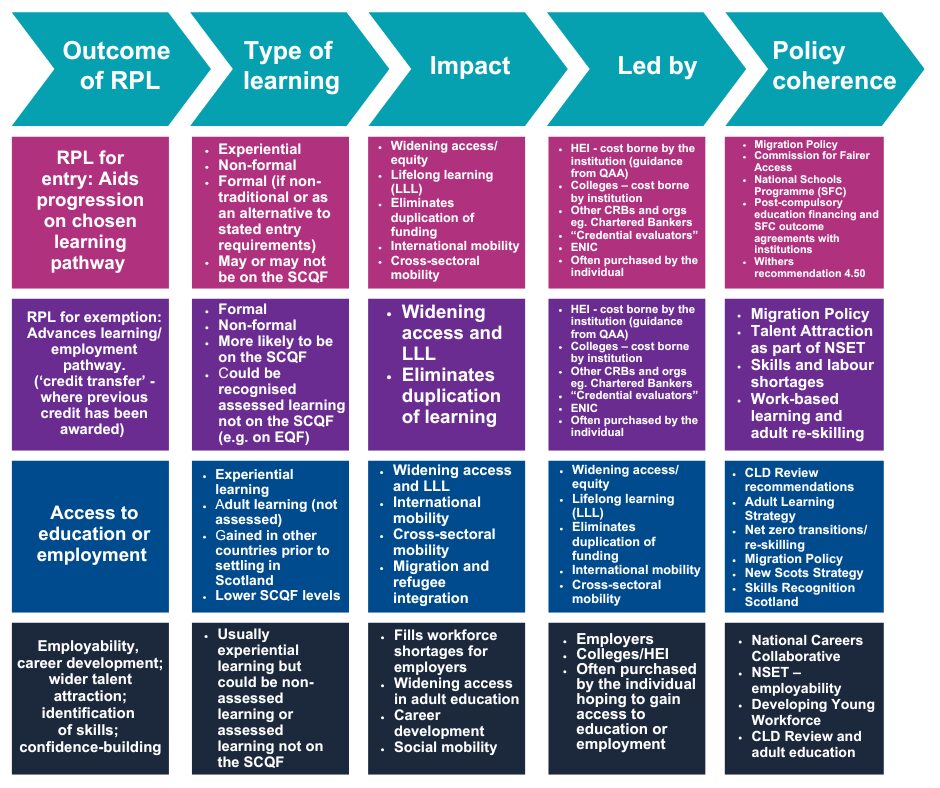
The SCQF Partnership has been calling for a national policy and strategy for RPL to be adopted by the Scottish Government for many years and in Autumn 2024 was invited to submit a proposal and business case for a national approach.
SCQF Partnership proposal to Scottish Government
Our proposal (contained in Annex 1) to Scottish Government stated that:
A coherent national system and overarching vision of learner entitlement to RPL will help ensure that all actors in education and skills are adopting and implementing RPL practices. The objective will be to embed the recognition of prior learning and skills of school leavers, adult learners, and those settling in Scotland within our education and skills system. This approach aims to value diverse learning pathways, enable shorter and more efficient progression routes, and align with labour market demands.
As a result, SCQFP recently secured Scottish Government commitment to developing a National System, through its stated Programme for Government published in May 2026.
“To capitalise on economic opportunities, we need people with the skills to grasp them.”
(Actions to enable this include):
“Establishing a national Recognition of Prior Learning system – formally acknowledging an individual’s skills and knowledge gained through work experience, training, or other learning outside of formal education.”
Ministers have supported the development of a system that properly values and acknowledges prior learning, skills and experience, enabling learners to gain credit/recognitions for existing skills, reducing the need to repeat learning and enabling quicker progression through education and training. Prior to the Scottish Parliamentary elections in May 2026, there is an expectation that a number of actions will be completed by Spring 2026:
Key actions required
- Assemble a steering group of employers, education providers (universities, colleges, training), and agencies, with international best practice input and focusing on leveraging existing resources and partnerships to agree a coherent, cost-effective approach to delivering a national approach.
- Develop a plan to streamline formal RPL for college and vocational students entering universities, using the Joint Articulation Group as the key vehicle for consultation and delivery (existing priority for the Scottish Funding Council).
- Focus on existing RPL and micro credentials pathways and processes and create a pilot programme for employers to utilise existing micro-credentials and benchmarking of skills using the SCQF through efficient informal RPL processes. Focus on priority industries with identified skills shortages.
Invitation to tender
Interested parties are invited to tender to deliver project management services to the SCQF Partnership with the primary objective of delivering the actions set out in the Scottish Government’s funding objectives for the SCQFP for fiscal year 2025-26 (as above).
The successful tenderer will report directly to the CEO and be provided with necessary secretariat, communications and project development support by the Head of Pathways Policy and the wider SCQFP team.
Specification for services
In the period from end June 2025-March 2026 the contractor will manage the delivery, with the support of the SCQFP team and its existing networks with employers and education providers, the following outputs:
- The creation and management of a National Steering Group for Scotland’s RPL System, which is inclusive in its approach and secures buy-in and ownership for a diverse range of interests, including Scottish Government officials, learners themselves, industry representation and tertiary institutions.
- A development plan for formal RPL for articulating students into HEI from college and vocational based learning pathways, embedding approaches developed by the Joint Articulation Group convened by universities and colleges, consulting with the Scottish Funding Council and the Commissioner for Widening Access.
- A road map, demonstrated through an action research pilot, for the use of informal RPL and micro-credentials by employers working in partnership with education and training providers and proposing cost-effective funding model for credit rating of micro-credentials in one priority industry. SCQFP will provide guidance on existing networks and relationships on which this will be built. Additional funding will be available for this activity.
- An evidence-based reporting framework for assessing the effectiveness of actions for regular, transparent reporting to the SCQFP Board of Directors, Scottish Government and the education and skills community
- Regular progress reports to the CEO and be prepared to discuss the project with the SCQFP Board and Scottish Government Ministers as/if required
- Identify additional early research and data analysis activity necessary to direct the focus of the development plan, for which additional funding will be made available.
Your approach
Interested parties are invited to review SCQFP’s original Proposal in Annex 1 and outline your approach to project management for this complex brief, involving a diverse range of actors in the Scottish education, skills, and economy landscape. Additional funding will be available to support the delivery of specific project deliverables, following agreement of a project development plan.
Your approach should consider:
- how you would approach defining clear roles, responsibilities, and performance reporting
- how you will approach the opportunities and risks for this project
- the membership of the Steering Group and its governance
- The inter-relationships within existing widening access, RPL and skills recognition initiatives and reporting structures in Scotland’s tertiary sector and how you would intend to avoid duplication of effort and competing agenda
- The need for ‘quick wins’ as well as longer term planning for delivery and future impact.
- Your resourcing of the project management, as a consultant or consultancy business sharing the delivery work across a number of consultants/ associates.
Budget
A budget of up to £30,000 (including VAT) is available for this work over an 8-month period. Contractors are invited to provide a breakdown of fees, including day rates and inclusive of all expenses.
Tender instructions
Tenders should include the following information:
- Your understanding of the brief and your proposed methodology
- Brief example/s demonstrating your record in delivering national level complex projects.
- Your project management approach, including a brief overview of roles, responsibilities and reporting.
- Key milestones within the contract period that you believe will be critical to delivery over the 8-month period.
- A high level, brief, risk assessment of the project and how you would intend to mitigate the risks and challenges encountered.
- The total fee (inclusive of VAT) for the contract period, for each element of service provided (or example, day rates of the project team), inclusive of all expenses.
- Brief CVs of the consultant/s who would deliver the service.
- Two referees /references of those who know your work.
- Your commitment to Fair Work, if employing staff.
- A written statement assuring SCQFP that you will have business insurance and be registered with HMRC tax purposes as a small business.
Please do not hesitate to contact Pauline Radcliffe if you require further information or would like to discuss prior to submitting a quotation.
E-mail: p.radcliffe@scqf.org.uk
Deadline for tender submission
Tenders, of no more than four pages (with CVs appended), should be submitted by Tuesday 10 June 2025 at 17.00 by email to Pauline, as CEO.
An initial inception meeting will arranged in the week beginning 23 June and thereafter contractor(s) will be required to work flexibly over the year ahead.
Assessment of tenders
Tenders will be assessed on the following criteria:
- Demonstrable executive level experience and a compelling reputation for delivery within the tertiary education and /or skills sector and with Scottish Government officials at a senior level
- A passion for and understanding of RPL Policy and processes, and its benefits for recognising wider learning and achievement and /or practical application of credit transfer within institutions.
- Your understanding of the project’s requirements and key milestones for delivery
- History in delivering complex projects, collaborating with diverse stakeholders and within challenging deadlines
- Evidence of understanding the challenges and risks associated with delivery the brief and how you might approach these
- The quality and experience of any proposed team as well as cultural fit
- Approach to wellbeing, equality, and diversity in the workplace
- Value for money.
Download tender document – https://scqf.verticaldev.org/wp-content/uploads/2025/06/SCQFP-ITT-RPL-Project-management-MAY25.docx