Scotland has no shortage of skills and talent. What it lacks is a consistently used Recognition of Prior Learning (RPL) system capable of recognising where and how learning has taken place.
Donnie Wood
Every day, people acquire valuable learning through life experience, employment, volunteering, military service, professional development, migration and community activity. Yet too often, that learning remains invisible when people seek to progress in education, employment or their careers.
The consequences are significant. People can repeat learning they have already achieved, employers can struggle to identify the full range of skills within their workforce, and individuals can face unnecessary barriers to progression. The result is wasted time, wasted talent and unnecessary cost for individuals, employers and the public purse.
What is RPL?
At its heart, RPL is a simple idea. Learning gained through experience should count alongside learning gained in classrooms.
The Scottish Credit and Qualifications Framework (SCQF) has a set of RPL principles adhered to by all of Scotland’s universities, colleges and Qualifications Scotland. These principles help maintain our ethos that ‘All Learning Counts’.
The challenge has been creating a level playing field within Scotland for all candidates to have their learning recognised.
And, importantly, many learners aren’t even aware that they can have their prior learning recognised.
A significant opportunity for Scotland
For decades, RPL has existed at the margins of Scotland’s education and skills landscape. It has been understood by practitioners, used sporadically, and commonly associated with articulation from college to university. However, a growing body of evidence suggests that RPL is not simply a process to speed up people’s learning journeys. It is potentially one of the most significant economic and social reforms available to Scotland in the coming decade.
Our research shows that RPL represents a major economic opportunity. Modelling suggests that increased RPL activity across a range of pathways could generate between £40 million and £152 million in additional Gross Value Added over ten years, alongside direct cost savings of between £37 million and £99 million. Combined economic benefits are estimated at between £77 million and £251 million, even under relatively modest adoption scenarios. Importantly, these figures only reflect selected sectors and pathways. The true impact could be considerably larger.
The economic case is compelling. But the social case may be just as important. A national RPL system also has the potential to widen opportunity for groups who often encounter barriers within traditional learning pathways. Adult returners, veterans, migrant workers, refugees and career changers, who frequently possess valuable learning, skills and experiences that remain unrecognised and undervalued.
Too often, adult learners have valuable skills and experience that go unrecognised and, as a result, they may have to repeat learning
For many of these individuals, progression is delayed not because they lack competence, but because the system lacks mechanisms to recognise learning, skills and competences.
The focus should shift from debating whether RPL is beneficial, to talking about how we should implement it.
The invisibility of RPL practices
Across higher education, professional sectors, colleges and workplaces, there are numerous examples of recognition of prior learning in action. The problem is that these practices remain fragmented, inconsistent and often invisible to those who would benefit most from them.
Countries that have successfully scaled RPL have not done so through policy statements alone. Australia, France and Ireland all demonstrate that growth occurs when national ambition is matched by funding, leadership and clear learner entitlements.
Scotland’s challenge is, therefore, not principally a procedural issue, but one linked to many social and economic factors.
The big question
The question facing Scotland is larger than RPL itself. It is about what kind of skills framework Scotland wants to build. One model continues to favour formal routes and institutional boundaries. The other starts from the premise that learning occurs everywhere and that the role of the RPL process is to recognise, validate and build upon it.
The evidence emerging from Scotland’s national RPL work, led by the SCQF Partnership at the request of the Scottish Government, suggests the latter approach is not only fairer but more economically efficient. It reduces duplication of learning, facilitates quicker progression routes, promotes faster movement into skills roles and creates better utilisation of existing skills.
The real opportunity lies not in creating another policy initiative, but in creating a new social contract around learning, one that values experiential learning as highly as formal qualifications.
What’s next for RPL in Scotland?
Our RPL Hub is packed with information for learners, employers and RPL advisors
The country already possesses the building blocks of RPL within the SCQF. The challenge now is finding the ambition to assemble them – and to make recognition of prior learning a routine part of how Scotland recognises skills, qualifications and progression.
If Scotland succeeds, RPL for experiential learning may come to be viewed not just in pockets of good practice, but as a cornerstone of a modern skills system and a wellbeing economy.
Our RPL Hub showcases inspirational examples of RPL in action across Scotland, highlighting the good practice already taking place and demonstrating the potential for these approaches to be adopted more widely.
Our RPL Network
To join the conversation and have your say, join our new LinkedIn network – Recognition of Prior Learning (RPL) in Scotland. The network will bring together people working in and around Recognition of Prior Learning (RPL) across Scotland – providing a space to share experiences, exchange ideas, showcase good practice and learn from one another.
The Scottish Credit and Qualifications Framework (SCQF) Partnership has announced an inspiring line-up of speakers and workshop hosts for its flagship SCQF@25 Conference, taking place at the Glasgow Science Centre on 22 September.
The conference marks the 25th anniversary of the SCQF – Scotland’s national qualifications framework – which has been helping learners, employers and educators understand and compare qualifications and learning achievements since 2001.
Hosted by Stuart McKenna, Chief Executive of the Scottish Training Federation, the event will bring together leaders from education, skills and industry to reflect on the Framework’s impact over the past quarter century and explore its role in shaping Scotland’s future skills and education landscape.
SCQF@25 keynote speakers
Among the keynote speakers is The Real David Cameron, an experienced mentor and consultant whose insightful perspective on education promises to provide delegates with fresh inspiration.
The conference will also hear from Dr Lee Coutts, Head Teacher of Ullapool High School, whose personal and professional journey exemplifies the transformative power of lifelong learning.
SCQF@25 workshops and hosts
Delegates will have the opportunity to participate in a series of interactive workshops exploring some of the key challenges and opportunities facing Scotland’s education and skills system:
Bridging the attainment gap with the SCQF, hosted by Dr Lee Coutts and John McGhee, Director of Education at Glasgow City Council.
Addressing skills gaps through apprenticeships, hosted by Rohaise Rose-Bristow, business owner and co-chair of the Apprenticeship Approvals Group, Michael Cusack, Chief Sustainability Officer at ACS Clothing and Tommy Breslin, Director of Scottish Union Learning.
Exploring Recognition of Prior Learning, hosted by Peter McGuire, Senior Lecturer at the University of the West of Scotland and Ross Short, Head of Fleet Capability at Babcock International.
How to get your qualification on the SCQF with third-party credit rating, hosted by Iain Hawker, Assistant Principal at Fife College, and Julie Wales, Head of Sector at Glasgow Clyde College.
The conference will conclude with a panel discussion featuring experts from across education, skills and industry, who will reflect on the future of qualifications, learning and workforce development in Scotland.
‘An opportunity to reflect’
Marissa Lippiatt, interim chief executive of the SCQF Partnership, pictured right, said: “As we celebrate 25 years of the SCQF, this conference provides an opportunity to reflect on the significant impact the Framework has had on Scotland’s education and skills landscape.
“We are delighted to welcome such an inspiring group of speakers and workshop hosts who will help us explore how qualifications, skills and lifelong learning can continue to support individuals and communities for the next 25 years and beyond.”
The SCQF@25 Conference is expected to attract representatives from schools, colleges, universities, employers, professional bodies, training providers and government organisations from across Scotland.
Showcase your organisation at SCQF@25. A range of sponsorship opportunities are available, offering valuable exposure and networking opportunities. View our sponsorship brochure for full details.
There’s a myth that engineering careers only start one way: school, Highers, university, done.
Meet the case that challenges that myth: an applicant who gained a Social Sciences degree in the early 2000s, retrained with a Sciences HNC in the late 2010s, spent years in non-engineering roles, and is now in their second year of a BEng (Hons) Graduate Apprenticeship in Engineering (Design and Manufacture) at Glasgow Caledonian University (GCU).
In employment since August 2024, they’re proof that the route into engineering is far more flexible than most people assume.
What is a Graduate Apprenticeship?
A Graduate Apprenticeship (GA) is a work-based degree where students attend university on day-release and spend the rest of the week applying what they’ve learned on the job.
GCU’s programme is built around three distinct streams – Computer-Aided Engineering, Control and Instrumentation, and Electrical Power Engineering Design – letting employers and apprentices pick whichever best matches the workplace they’re in.
It’s a model designed to work for two very different kinds of applicant: new recruits starting their career from day one, and existing employees looking to formalise and extend skills they’ve already built up on the job.
Both routes lead to the same destination: on graduation, apprentices are eligible to apply for Incorporated Engineer (IEng) professional registration, with the course itself accredited by the IMechE, the IET and InstMC.
The entry requirements — and why maths is the sticking point
For entry to year 1 at university (SCQF level 7), the standard entry route asks for level 6 Scottish Highers at BBCC, including Higher Maths and another science. Alternatively, an HNC relevant to the chosen stream with at least a B in the graded unit, including both Engineering Maths 1 and Engineering Maths 2.
Maths is critical to an applicant’s success on this programme and the entrance requirements are stringent, however GCU runs a Maths summer programme for applicants who have just fallen short of the entrance requirements in this subject.
A career that didn’t fit the standard mould
This is where our case study applicant comes in. Their journey to a new career was anything but linear:
A Social Sciences degree, completed in the early 2000s
A Sciences HNC, undertaken in the late 2010s
Various non-engineering job roles in between
Finally, recruitment as a Graduate Apprentice — the point at which everything changed
That CV doesn’t really point towards engineering as a career. And under a conventional entry system, it might well have been a dead end. What made the difference was a combination of Recognition of Prior Learning (RPL) and the apprenticeship’s employment structure. Together, they opened up a career path that simply hadn’t existed for this person before.
How Recognition of Prior Learning works
The applicant’s previous qualifications and experience were taken into account to assess their suitability for the programme, with a Maths summer programme helping to fill any gaps in knowledge or skills.
In this case, the evidence produced for this RPL application was outstanding, and with this, the results were remarkably specific:
Analysing engineering problems with complex features — met through describing an engineering solution to a real problem encountered in a pre-apprenticeship job
Designing, developing, simulating, building, testing and evaluating solutions — met through project work completed during HNC study
Investigating emerging technologies — met by explaining an understanding of 3D printing
Communicating engineering concepts clearly — met with a practical, workplace-relevant example
Knowledge across multiple engineering disciplines — met through self-directed explanation of several engineering areas
Understanding engineering’s impact on society and environment — met with a focus on renewable energy and its broader societal benefit
Electronic and microcontroller-based systems — met by explaining the operation of equipment from a former workplace that used these systems
Applying engineering knowledge across contexts — met with an example drawn from personal life
Algebra, geometry, trigonometry, calculus and statistics — met by citing relevant modules from previous study
Numeracy skills — again evidenced through previous coursework
Mathematical reasoning and complex modelling — met by describing how these skills were used in writing the dissertation for their most recent qualification
RPL is a thorough process which is rigorously assessed in the same manner as if the applicant had undertaken the study in the classroom.
The bigger principle at work
Strip away the specifics of this one applicant’s story, and you can see the underlying method GCU applies to every RPL case:
Determine the essential requirements of the programme
Develop a process to assess applicants against those requirements
Assess the applicant against them, fairly and rigorously
Iterate, as many times as it takes, to give the applicant the best possible chance of demonstrating what they know
It’s that fourth step that matters most. RPL isn’t a one-shot test; it’s an iterative, supportive conversation between institution and applicant, designed to surface knowledge and ability that a conventional application form would never capture.
Why this matters beyond one applicant
This case study is a useful reminder that non-traditional routes into engineering aren’t a workaround or a lesser path: they’re a deliberate, well-designed part of how Graduate Apprenticeships function.
A degree in an unrelated subject, a career spent doing something else entirely, and a genuine curiosity about how things work can, with the right assessment process behind it, add up to a legitimate and rigorous entry point into a BEng (Hons) engineering qualification at SCQF level 10.
For employers, it’s a signal that talent already sitting inside the business – in roles that look nothing like engineering on paper – might be closer to apprentice-ready than anyone assumed.
With engineering facing a well-documented skills shortage across the UK, routes like this one matter more than ever.
By widening the doorway into the profession rather than narrowing it, this Graduate Apprenticeship is quietly helping to build the pipeline of engineering talent the sector urgently needs.
Founded in 1413, the University of St Andrews is Scotland’s oldest university – and ranked Top University in Scotland. But here’s something that might surprise you: you don’t need straight As, a traditional background or even a recent qualification to study here.
Students Natalie and Amanda
The MA in Combined Studies is St Andrews’ part-time evening degree for adults returning to education. There are no formal entry requirements, and no pressure to follow a set path. It’s a flexible way to work towards a world-class degree, around your life and on your terms.
The course allows you to study in the evenings to work towards a degree. During the course, you will be able to choose from a wide range of subjects based on your interests.
A degree that works around you
Study part-time over four to nine years, balancing lectures around work, family and everything life throws at you. Classes are delivered in a flexible hybrid format – attend on campus, join live online or mix both depending on what works best that week.
“I was working full time and studying all at the same time. There were times when I used to say to my husband, I don’t know if I can do this — but I had a choice, I could have given up, but I didn’t want to.” – Amanda
Your experience counts
The programme takes a broader view of your experience. Your work history, caring responsibilities and life experience all matter. And if you already have relevant qualifications, Recognition of Prior Learning (RPL) could give you advanced standing, meaning you may be able to complete your degree in up to half the time.
“When I was at school, university just wasn’t an option. There were certain people who went and everyone else had to leave and find work. I didn’t know whether they would allow me [onto the programme] … but they did.” – Caroline
For everyone who thinks that university is not for them
The students on this programme come from all walks of life. Some haven’t studied in decades. Some never thought university was within reach. Some just needed a nudge from a friend.
“Joanne saw it on Facebook and she didn’t have the confidence to come herself – and I wouldn’t have had the confidence to come myself. We were just like, let’s do it.” – Nicola
“School was horrible for me. I hated it. Doing this makes me realise I can actually do something and my brain does work.” — Joanne
More than a qualification
Ask any student what they’ve gained, and it’s about much more than a certificate.
“Being in a classroom and somebody saying ‘I didn’t see it like that, but now I get what you’re saying’ has given me the confidence to know that I do have an opinion, I do have a voice. It’s probably the biggest thing I’ll take away from doing this course.” – Amanda
“You’ll be amazed at how much you love to learn when you actually have the chance to learn. It’s amazing, absolutely amazing.” – Nicola
“It’s kind of an honour to have this chance. A lot of people in the world don’t get it – and it’s such a special thing to learn.” – Caroline
Charles Clark
“There’s a whole world of discovering things out there – and this is a very, very good way of doing it.” – Charles
Whatever your background or starting point, there’s a place for you here.
The course has two entry points each year, in September and January.
September 2026 – direct applications are now closed
January 2027 – applications will open on 14 September 2026
September 2027 – applications will open 5 April 2027
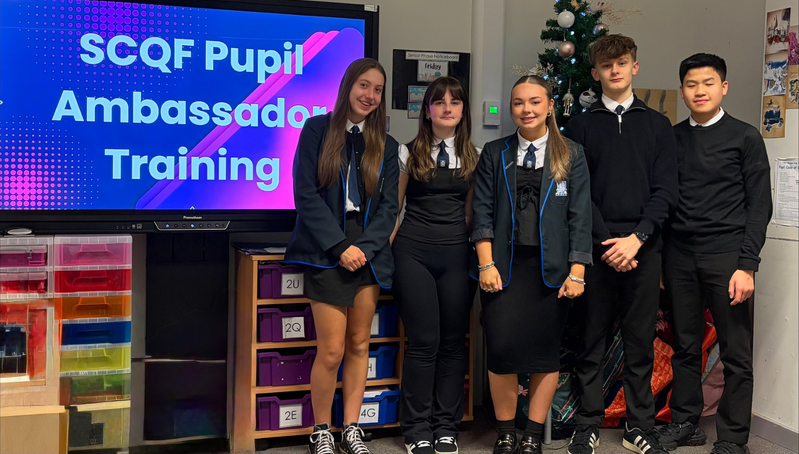
When Port Glasgow High School started their SCQF Ambassador journey, they didn’t hang around.
Within months, they’d gone straight to Silver status – a real testament to the effort put in by staff and pupils alike. Now they’ve got their sights set on Gold.
Here’s how they got there.
How it all started
It began in June 2025 when Donnie Wood from the SCQF Partnership came into the school to chat with staff and get everyone up to speed on the SCQF and what it could mean for young people. That initial conversation sparked something, and by May 2026 Port Glasgow High had been awarded their Silver SCQF Ambassador status.
Getting the word out
Once the school was on board, the next challenge was making sure pupils, parents and the wider community understood what the SCQF is – and why it matters.
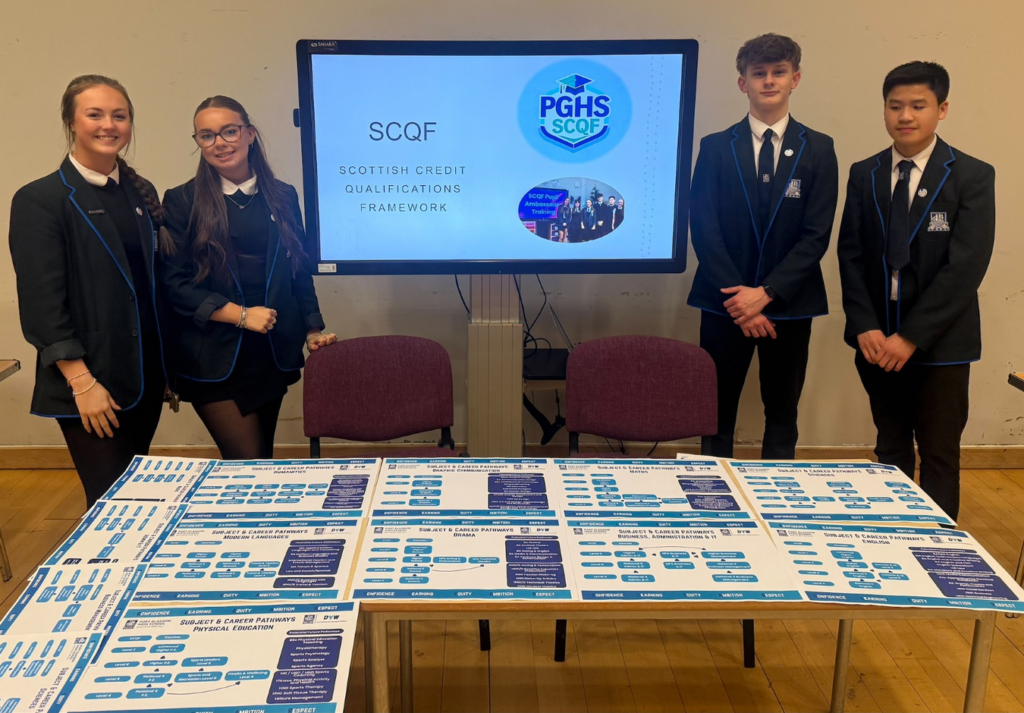
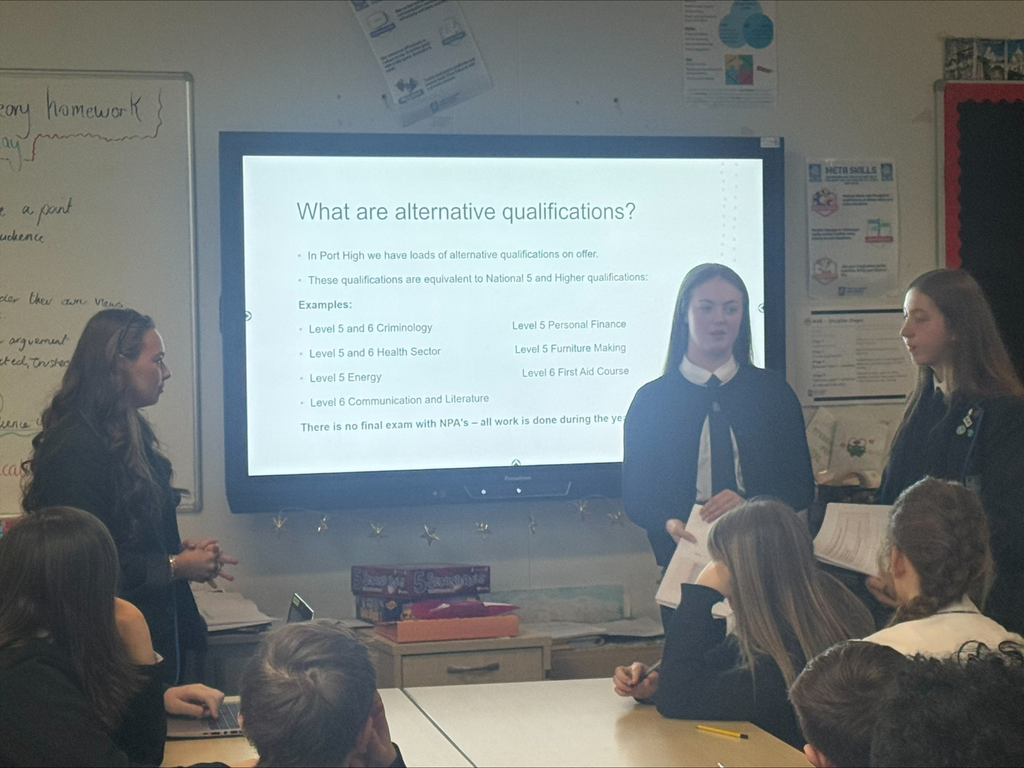
Pupil Ambassadors took the lead on this, heading into classrooms across the school to talk to their peers directly. There’s something powerful about hearing it from another student rather than a teacher, and the Ambassadors did a great job breaking down what the Framework is, why it’s worth knowing about, and what learning programmes are being delivered at Port Glasgow High.
They didn’t stop at the classroom door either. Ambassadors supported the Options Fayre and parents’ nights to talk families through the different pathways available. This means that parents and carers are equipped with the knowledge and information they need to support their young person in making the right decisions for their future development.
The school has also been keeping their entire school community in the loop through their newsletter and social media, giving regular updates on progress and making sure the conversation keeps going beyond the school gates.
A broader curriculum
Alongside all the Ambassador work, Port Glasgow High has been quietly but steadily expanding what’s on offer for pupils. They now have NPA courses at both SCQF Levels 5 and 6, including programmes like SCQF level 6 Business with IT and SCQF Level 5 Energy, as well as life skills opportunities such as SCQF Level 6 First Aid Training.
These aren’t just boxes to tick. They’re courses with real practical value, linked to employment and further study, and designed to open doors for pupils who might not thrive in a traditional exam-only environment.
What pupils are saying
The proof, as always, is in what the young people themselves think:
Doing NPAs this year has helped me develop skills I can take to college and work.
I enjoyed doing courses like the first aid training. It will help make me employable.
And from a former pupil already putting it into practice:
I did an NPA that helped me develop transferable skills I now use at work and on my college course.
What’s next?
Port Glasgow High is already looking ahead to the 2026/27 school session with a clear goal: going for Gold. They’re actively recruiting more Pupil Ambassadors to help push things forward and keep building on the momentum they’ve already created.
An impressive start – and if the jump to Silver is anything to go by, Gold won’t be far off.
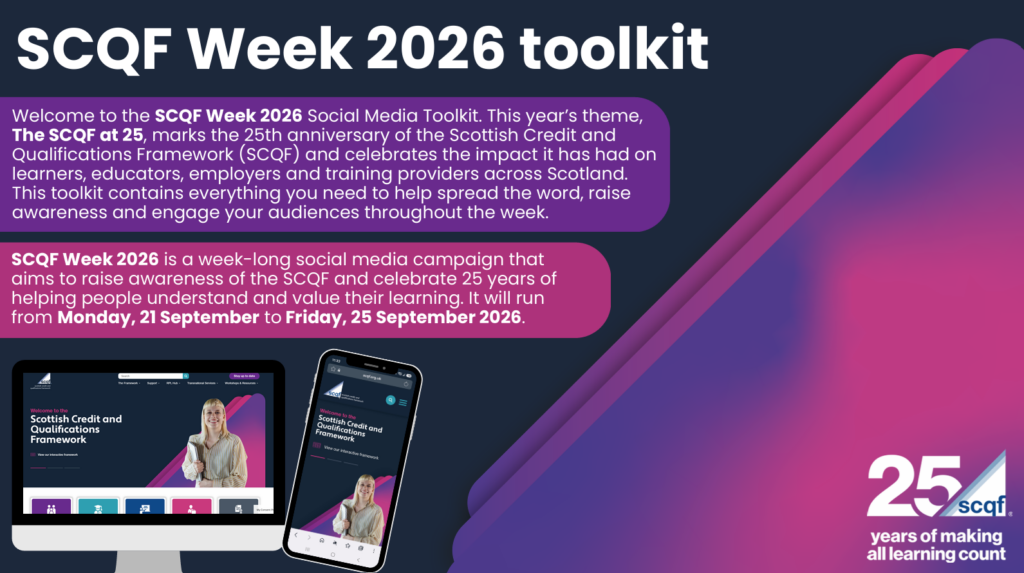
The countdown is on to SCQF Week 2026, and this year we have even more reason to celebrate.
SCQF Week is extra special as we are marking 25 years of the Scottish Credit and Qualifications Framework (SCQF).
From 21 to 25 September, we’ll be looking back 25 years to explore people’s learning journeys and celebrate how far they’ve come.
We’ll be shining a light on the many different ways people learn, the skills and knowledge they gain, and how learning can be recognised and valued throughout life.
Looking to the next 25 years
As we reflect on the past 25 years, we’ll also look to the future and ask: what will learning look like in 2051?
With new technologies, new careers and new ways of learning already changing the way we live and work, there’s plenty to think about.
How to take part
Join us for SCQF Week 2026 as we celebrate 25 years of learning, recognition and opportunity – and look forward to the next 25.
Follow along on social media and join the conversation using #SCQFWeek26 and #SCQF25Years.
For more for information and to download our social media toolkit, visit SCQF Week 2026.
SCQF@25 Conference
To celebrate 25 years of the SCQF, we’re also hosting our SCQF@25 conference in Glasgow on 22 September, bringing together colleagues and partners to reflect on the SCQF’s journey and look ahead to the future of learning. Find out more and book your tickets here: Inspiring line-up of speakers announced for SCQF@25 conference.
You’ve spotted “SCQF credit-rated” — level 5, level 7 — on our courses and thought: what does that actually mean south of the border? Here’s the plain-English translation — straight from the official comparison tables.
If you manage estates, engineering or compliance teams in England, you’ll be fluent in the language of A-levels, NVQs, HNCs and “level 3” or “level 4” qualifications.
So when a training course arrives on your desk described as SCQF level 5 or SCQF level 7, credit-rated through Qualifications Scotland, it’s fair to ask two questions. What is the SCQF? And is it actually recognised in England?
The short answers: it’s Scotland’s national qualifications framework – the sibling of the system you already know – and yes, it’s formally recognised right across the UK.
But the detail matters, because SCQF numbering looks different from English numbering, and misreading it is easy. This guide gives you the official translation.
What is the SCQF?
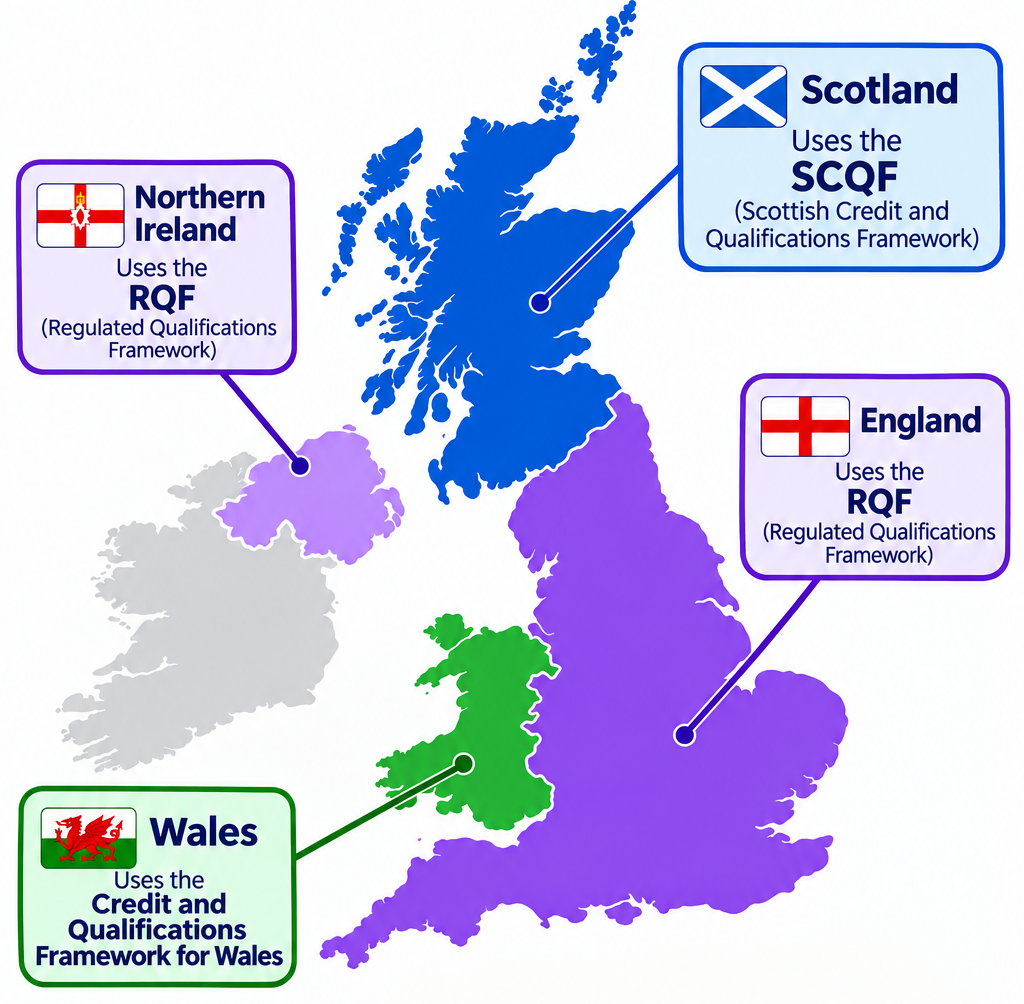
The Scottish Credit and Qualifications Framework (SCQF) is Scotland’s national framework for qualifications, in the same way England and Northern Ireland use the Regulated Qualifications Framework (RQF), overseen in England by Ofqual.
Almost every mainstream qualification achieved in Scotland – from school qualifications to doctorates, and including vocational and professional training – sits somewhere on the SCQF.
Every programme on the Framework carries two numbers:
An SCQF level (1 to 12) – how demanding the learning is. Level 1 covers the most basic learning outcomes; level 12 is doctorate territory.
Credit points – how much learning is involved. One SCQF credit point represents ten notional hours of learning, including study and assessment time, not just classroom hours.
So a qualification badged “SCQF level 7, 6 credit points” tells you at a glance both the intellectual demand and the volume of learning behind it.
That precision is the whole point of the Framework – and it’s exactly what a certificate of attendance can’t tell you.
The English translation: SCQF vs RQF
Here’s where English readers usually stumble. The SCQF runs from 1 to 12; the RQF runs from Entry Level to Level 8.
The numbers do not line up one-for-one, so a Scottish level always looks higher than its English equivalent. An SCQF level 7 qualification is not the same as an RQF Level 7 (which is master’s degree level) — and, equally, it’s well above an RQF level 3.
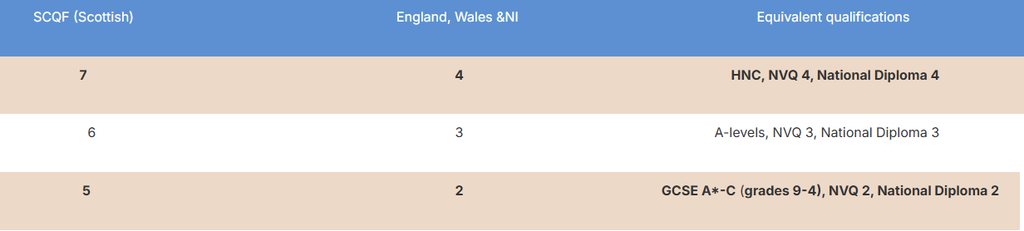
The table below shows the levels you’ll most often meet on technical training, drawn from the official comparison published by Qualifications Scotland (formerly the Scottish Qualifications Authority, SQA):
National framework qualifications comparison table
The full official table covers all 12 SCQF levels, right up to doctorate (SCQF 12 = level 8 in England).
An SCQF level 7 qualification sits a full step above A-levels — the same rung as an HNC in England.
Worked examples: SCQF levels 5 and 7 in English terms
Take the two levels you’ll most often meet on technical training. An SCQF Level 5 qualification corresponds to RQF Level 2 in England – GCSE standard (A*–C /grades 9–4) – the level at which someone can competently carry out skilled, well-defined technical tasks to established procedures.
An SCQF level 7 qualification corresponds to RQF level 4 – beyond A-level standard, in the same territory as an HNC or the first year of a degree – demanding critical understanding, analysis and evaluation of complex technical information.
The point isn’t these two levels in particular: the Framework works identically at every one of its 12 rungs.
Whatever level appears on a credit-rated course – ours included, from operational programmes at SCQF level 5 to our 5-Day Authorised Person (Ventilation) training at SCQF level 7 — the same official table translates it into its English equivalent.
Is an SCQF qualification recognised in England?
Yes. This is the question we’re asked most often by English clients, and the answer is unambiguous.
The SCQF and the RQF are formally referenced against each other, and both are referenced against the European Qualifications Framework (EQF).
Qualifications from either framework are treated as comparable at the mapped level across the UK – an SCQF-credit-rated programme is no more “just Scottish” than an English HNC is “just English”.
Insight for procurement teams
When a tender or competence audit asks for evidence of accredited training, cite the SCQF level, the credit points and the credit-rating body, and include the RQF equivalence from the official Qualifications Scotland comparison table. That combination answers the “is it recognised?” question before an auditor needs to ask it.
Credit-rated training vs a certificate of attendance
Understanding the levels is half the story. The other half is the phrase credit-rated – and this is where the framework earns its keep for compliance buyers.
A great deal of technical training in the UK is certificated only in the sense that you receive a PDF for turning up. Nobody independent has assessed how demanding the course is, how much learning it involves, or whether the assessment proves anything.
Credit rating is different. Before a programme can join the SCQF, a credit rating body – in our case, working with Qualifications Scotland – must scrutinise it and formally confirm three things:
Its level – the learning outcomes genuinely sit at the claimed point on the Framework;
Its credit points – the notional learning hours have been measured and verified;
Its quality assurance – the design, delivery and assessment have been independently checked.
A certificate of attendance proves someone was in the room. A credit-rated qualification proves what they can now do.
For healthcare estates in particular, that distinction has teeth. Guidance such as HTM 03-01 (specialised ventilation in healthcare premises) expects authorised persons and other key roles to be demonstrably competent.
When your training evidence carries an SCQF level and credit points, competence stops being an assertion and becomes a verifiable record.
What this means for your team
M&M Consultancy & Training Services is based in Scotland, and our courses are credit-rated to the SCQF- but the majority of the standards we train against, from HTM 03-01 to its Scottish counterpart SHTM 03-01, apply on both sides of the border, and our courses are developed and delivered by NHS-appointed authorising engineers who work UK-wide.
For an English employer, choosing an SCQF credit-rated course means:
Recognition – a nationally qualification at every level of the framework (SCQF level 5 maps to NVQ level 2; SCQF level 7 to NVQ level 4)
Audit-ready evidence – level and credit points that slot directly into a competence management system;
Comparability – a common currency for mixed teams holding Scottish and English qualifications.
Frequently asked questions
What is SCQF level 7 equivalent to in England?
RQF level 4 – a step above A-levels, comparable to an HNC or NVQ 4, according to the official Qualifications Scotland comparison table.
What is SCQF level 5 equivalent to in England?
RQF level 2 — broadly GCSE standard (A*–C /grades 9–4), alongside NVQ 2. The same official comparison table covers every SCQF level, so any credit-rated course can be translated the same way.
Is SCQF the same as an NVQ?
No. An NVQ (or SVQ in Scotland) is a type of qualification; the SCQF is the framework the qualification sits on. SVQs, HNCs, degrees and credit-rated professional courses all occupy levels on the same framework.
Do English employers and auditors accept SCQF qualifications?
Yes. Because the SCQF and RQF are formally referenced against each other and against the EQF, an SCQF credit-rated qualification is recognised UK-wide. Quote the level, credit points and the RQF equivalence in your competence records.
Get to know the people behind the SCQF Partnership (SCQFP). In this new blog series, we shine a spotlight on our Board members and the valuable experience, perspectives and leadership they bring to the organisation. This week, it’s the turn of Martin Jones.
Martin has over 30 years’ experience in tertiary education, primarily working within a law school environment.
During 15 years at Glasgow Caledonian University (GCU), he held a number of leadership roles, including leading the law team.
More recently, he has worked within the University of the Highlands and Islands as Principal and CEO at UHI Argyll.
In 2025, he became Dean and CEO of the Institute of Law, Jersey.
An advocate for technology in learning, he is passionate about widening access to the legal profession and is a member of the Law Society of Scotland’s Education and Training Committee.
As we celebrate the 25th anniversary of the SCQF, we caught up with Martin to learn more about his vision for the Framework’s future.
What’s been the most rewarding aspect of serving on the Board?
Seeing key representative stakeholders in Scotland’s educational landscape engage around the Framework as an important calibration of education and training in Scotland and how that is never more relevant than today. Also seeing, how the SCQFP’s impact is driven by a relatively small team of dedicated staff.
What do you see as the SCQF’s most important contribution to Scottish education and skills development in the past 25 years?
The opportunity that the Framework gives for learners to situate themselves within the levels and to plot an individual journey which may be navigated in a concentrated burst through school, college, university and workplace or alternatively in a more ad hoc fashion over a considerable number of years – but all tied together with a sense of benchmarked, coherent progression.
How do you see the SCQF evolving over the next 25 years?
The adoption of the Framework wherever learning and skills acquisition takes place has been central to the last 25 years.
Those opportunities for learning will likely expand in the context of digital offerings and may emerge in ways that are not entirely obvious at this moment in time and from providers that may be outside traditional contexts too.
The need for SCQF to remain present and to anchor learning as people are driven to learn to remain relevant in a changing job market will be paramount.
Can you share an example of how you’ve seen the SCQF make a real difference to learners, training providers & employers?
In my former working life at UHI Argyll seeing the Framework being used to plan and create coherent learner pathways from school through college and university qualifications in a single tertiary institution is exactly how it can be used strategically for individual benefit.
Also, at Ocean Youth Trust (Scotland) I saw how the achievement of benchmarked qualifications achieved in the context of a boating adventure was so important to some young people who may have struggled to achieve the equivalent at school.
Why should learners, training providers and employers care about the SCQF?
I would highlight, in particular, the role of employers in looking at the range of qualifications that any potential employees might be bringing to the table and, therefore, be looking at them as individuals.
Equally, when planning to invest in the education and training of their employees, it enables them to make the right decision about what is the best next step for the benefit of the organisation and the individual.
What makes the Partnership model effective for Scotland’s qualifications landscape?
Partnership is just that. Nobody can ‘own’ the SCQFP or set its agenda without collaborating with the voices from all corners of the skills and education landscape in Scotland.
That is also reflective of the fact that learners will likely engage with the various constituent parts across their lifetime.
What’s one thing you would like more people to understand about the SCQF?
Engaging with the Framework is not a single linear journey to reach the highest pinnacle that you can in a particular specialism.
The nature of learning and skills acquisition is such that you may have concurrent or parallel journeys as you develop your career, change career or engage for the love of learning across your lifetime.
Glossary Term
Authority
Appears at Level 12 only where it is used in the phrase ‘demonstrate substantial authority’, reflecting a recognised high level and depth of expertise/expert knowledge and understanding, along with confidence. It does not mean ‘exercise authority over staff and resources’ etc, as that could clearly apply at earlier levels.
Glossary Term
Exercise
Used in connection with management and/or supervisory responsibility, denotes a requirement of a formal, substantive role.
Glossary Term
Directive
Applied to ‘supervision’, signifies a task or activity that is guided.
Glossary Term
Graphical Data
Encompasses maps, plans, diagrams, tables and graphs.
Glossary Term
Synthesis
Combine discrete elements into a coherent whole.
Glossary Term
Analysis
Examine in detail with a view to explanation and interpretation.
Glossary Term
Present
Set out, put forward, deliver information using a variety of mediums as appropriate.
Glossary Term
Hypothetical
Supposed, assumed for the sake of argument.
Glossary Term
Straightforward
Clear and uncomplicated activity, but not as demanding or systematic and therefore not as advanced as ‘routine’.
Glossary Term
Creativity
Often used in combination with ‘originality’. There is overlap in definition, but the defining characteristic of creativity appears to be imagination.
Glossary Term
Originality
Often used in combination with ‘creativity’. There is overlap in definition, but the defining characteristic of originality appears to be independence.
Glossary Term
Professional
Used throughout as an adjective and applied to terms including level, skills, techniques, practices, contexts, and issues where it bears broad interpretation as ‘behaving appropriately/doing things properly and well and to notions of accepted, (including externally) prescribed standards’, as well as narrow, relating to a specific occupation designated as a profession. In this latter sense, the term applies in all contexts including academic study, eg footnoting properly.
Glossary Term
Unfamiliar
New territory for an activity.
Glossary Term
Routine
Used as an adjective throughout and applied to terms including skills, tasks, elements, practices, contexts, methods and problems where it describes activity that is standard, usual, unvarying, customary, common.
Glossary Term
Everyday
Slightly more advanced and beyond personal but a known experience/activity encountered/applied regularly - less advanced than ‘familiar’.
Glossary Term
Familiar
Often encountered or experienced; common; something one has a good knowledge of - more advanced than ‘personal’ and ‘everyday’, not as advanced as ‘routine’.
Glossary Term
Personal
An experience relating only or primarily to the person – one would expect to start here then widen out into the rest of the world, so not as advanced as ‘familiar’.
Glossary Term
Critical
Fully informed, capable of supporting in-depth analysis and assessment.
Glossary Term
Discerning
Using judgement to recognise differences but not fully equipped/informed to analyse and discuss them in depth, so less advanced than critical.
Glossary Term
Awareness
Consciousness, including a background consciousness. Can be a starting point for further exploration.
Glossary Term
Appreciation
A sense, perception, a hold, fix or grasp of one or more of the various aspects of a subject/discipline/sector.
Glossary Term
Understanding
A thorough and firm grasp of a subject/discipline/sector or an element or elements of it, derived from education/study, experience and reasoning in appropriate combination. Can be defined as ‘know why’, as opposed to ‘know that’. More holistic knowledge of processes and contexts, so more advanced than appreciation and knowledge.
Glossary Term
Simple
Undemanding activity not necessarily part of a formal structure - not as advanced as ‘basic’.
Glossary Term
Knowledge
Facts, ideas, theories and concepts in a subject/discipline/sector acquired through experience and/or education – a surer grasp than appreciation so more advanced.
Glossary Term
Basic
Activity is early stepping stone on a structure or framework that can be built upon – more advanced than ‘simple’.
We and our partners use information collected through cookies and similar technologies to improve your experience on our site, analyse how you use it and for marketing purposes. You can find out more in our privacy policy, and manage your consent at any time.
We and our partners use information collected through cookies and similar technologies to improve your experience on our site, analyse how you use it and for marketing purposes. Because we respect your right to privacy, you can choose not to allow some types of cookies. However, blocking some types of cookies may impact your experience of the site and the services we are able to offer. In some cases, data obtained from cookies is shared with third parties for analytics or marketing reasons. You can exercise your right to opt-out of that sharing at any time by disabling cookies.
These cookies and scripts are necessary for the website to function and cannot be switched off. They are usually only set in response to actions made by you which amount to a request for services, suchas setting your privacy preferences, logging in or filling in forms. You can set your browser to block oralert you about these cookies, but some parts of the site will not then work. These cookies do not store any personally identifiable information.
Analytics
These cookies and scripts allow us to count visits and traffic sources, so we can measure and improve the performance of our site. They help us know which pages are the most and least popular and see how visitors move around the site. All information these cookies collect is aggregated and therefore anonymous. If you do not allow these cookies and scripts, we will not know when you have visited our site.
Embedded Videos
These cookies and scripts may be set through our site by external video hosting services likeYouTube or Vimeo. They may be used to deliver video content on our website. It’s possible for the video provider to build a profile of your interests and show you relevant adverts on this or other websites. They do not store directly personal information, but are based on uniquely identifying your browser and internet device. If you do not allow these cookies or scripts it is possible that embedded video will not function as expected.
Google Fonts
Google Fonts is a font embedding service library. Google Fonts are stored on Google's CDN. The Google Fonts API is designed to limit the collection, storage, and use of end-user data to only what is needed to serve fonts efficiently. Use of Google Fonts API is unauthenticated. No cookies are sent by website visitors to the Google Fonts API. Requests to the Google Fonts API are made to resource-specific domains, such as fonts.googleapis.com or fonts.gstatic.com. This means your font requests are separate from and don't contain any credentials you send to google.com while using other Google services that are authenticated, such as Gmail.
Marketing
These cookies and scripts may be set through our site by our advertising partners. They may be used by those companies to build a profile of your interests and show you relevant adverts on other sites. They do not store directly personal information, but are based on uniquely identifying your browser and internet device. If you do not allow these cookies and scripts, you will experience less targeted advertising.
Facebook Advanced Matching
Facebook Advanced Matching can improve ads attribution and conversion tracking. It can help us reach better-targeted custom audiences through our ads. When possible, we will share with Facebook hashed information like your name, phone, email, or address.
Facebook CAPI
Facebook Conversion API Events (CAPI) help us better understand how you interact with our websites. They allow us to measure the impact of our ads on the website's conversions and they improve ads targeting through custom audiences. When possible, we might share with Facebook information like name, email, phone, address.