
The SCQF Partnership is updating its database of consultants who may be interested in supporting our work on a project-by-project basis.
From time to time, we engage consultants with specialist knowledge and experience in areas relevant to the SCQF, including Recognition of Prior Learning (RPL) and other aspects of qualifications, learning and skills development.
If you would like to be considered for future opportunities, please complete and submit the form below to be added to our consultant database.
We will keep your details on file and contact you if a suitable opportunity arises. Please note that joining the database does not guarantee future work or create any obligation for the SCQF Partnership to engage your services.
Download Consultant Interest Form
Qualifications Scotland (formerly SQA) results are due on Tuesday, 4 August, 2026.
If you have signed up to My Qualifications Scotland, you will receive your results by text or email. Everyone will also receive their results certificate by post.
SCQF levels and credit points are included in all Scottish qualifications certificates, so understanding what these mean can help when making decisions about your future learning or career options.
Watch our video below to learn more.
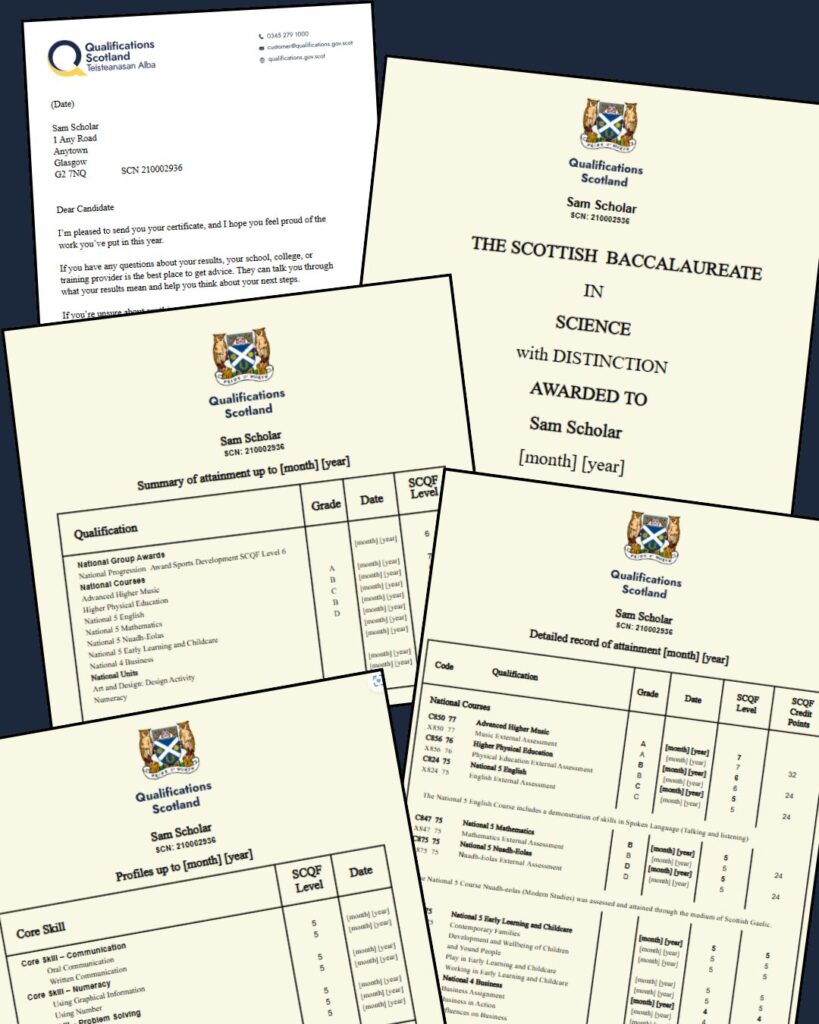
Your Scottish Qualifications certificate
Inside the envelope, you will receive:
- A letter, which has a short message and it may also state that you have not passed the subjects/courses listed.
- A commemorative certificate if you have passed a certain qualification – the full list is on the Qualifications Scotland website here.
- A summary of attainment, which shows all the SQA/Qualifications Scotland qualifications you’ve passed since 1995, including their SCQF level.
- A detailed record of attainment, which features the SCQF level and credit points for each qualification listed.
- A profiles page, which outlines the core skills you’ve gained while completing the qualifications, and their SCQF level. It also outlines the total number of credit points you’ve gained at each SCQF level. An explanation of SCQF levels and credit points is featured below.
What is the SCQF?
The SCQF is the Scottish Credit and Qualifications Framework and it provides a way of comparing Scottish qualifications. The Framework features the qualifications you will achieve at school, college, university and many other qualifications you may go on to achieve at work or in the community. Each qualification has an SCQF level and credit points.
What are SCQF levels?
The Scottish Credit and Qualifications Framework has 12 levels. The different levels indicate the level of difficulty of a particular qualification, with 12 being the most challenging.
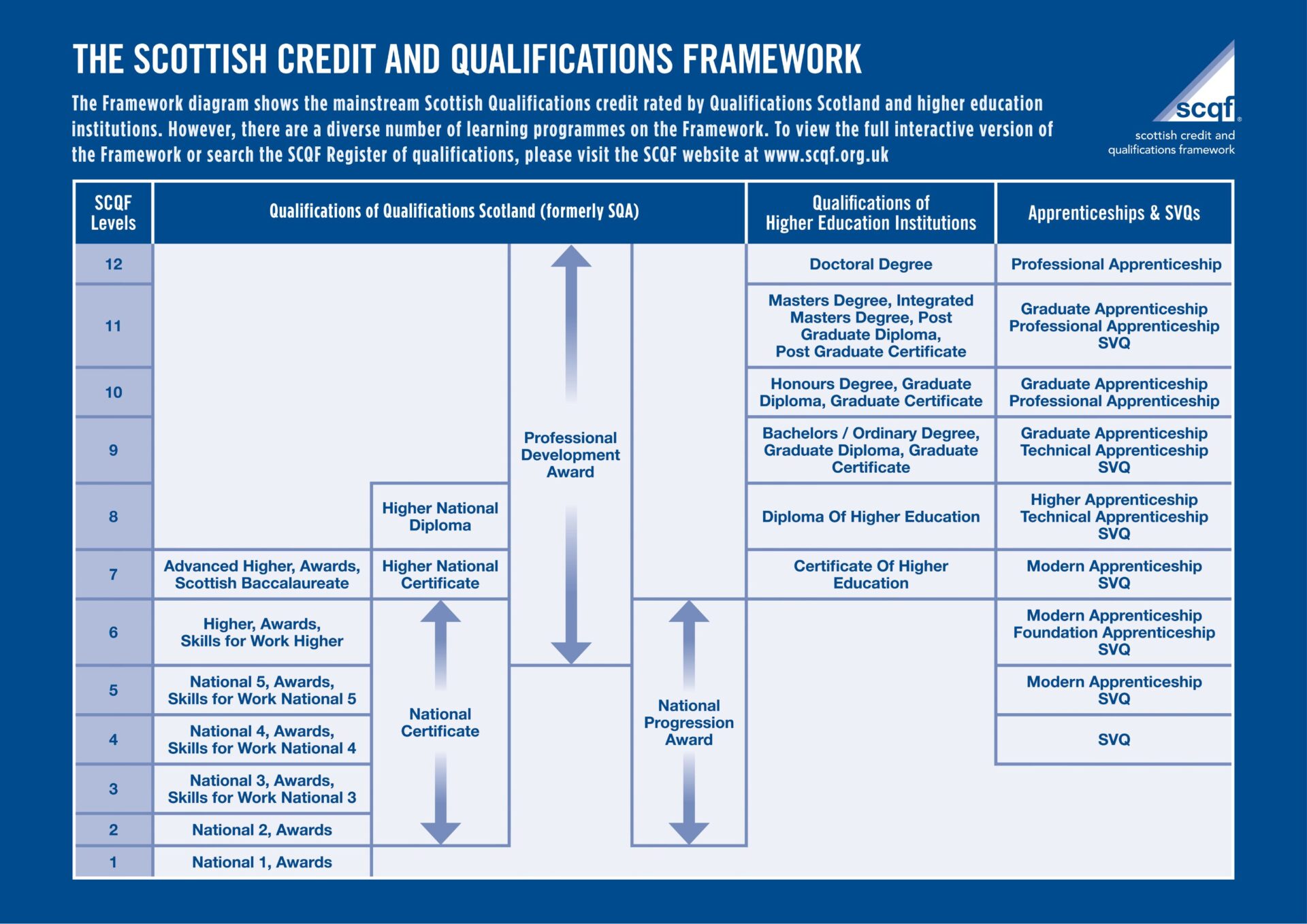
Find your level of learning and compare qualifications on our interactive framework diagram
What are SCQF credit points?
Credit points are a way of showing how much time it takes, on average, to complete a qualification or learning programme. They allow learners, learning providers and employers to compare different qualifications at the same or even different levels.
One credit point is approximately 10 hours of learning. For example, 15 credits involves 150 hours of learning.
What is the SCQF for?
The SCQF makes it easier to describe, compare and understand qualifications. Before the SCQF, there was no easy way to compare different qualifications. Now it is easy to see that, for example, a National Progression Award (NPA) at SCQF Level 5 is at the same level as a National 5. Most Scottish universities and colleges now use SCQF levels and credit points to describe their courses.
The SCQF can:
- help you plan your learning and make the right choices;
- help employers understand your qualifications;
- help universities or colleges identify the level you have studied at in a particular subject, and make it easier to transfer credits between different learning programmes;
- increase your confidence by showing you the level of learning you have achieved; and
- recognise other areas of formal and informal learning or skills that may help you to develop and achieve your goals.
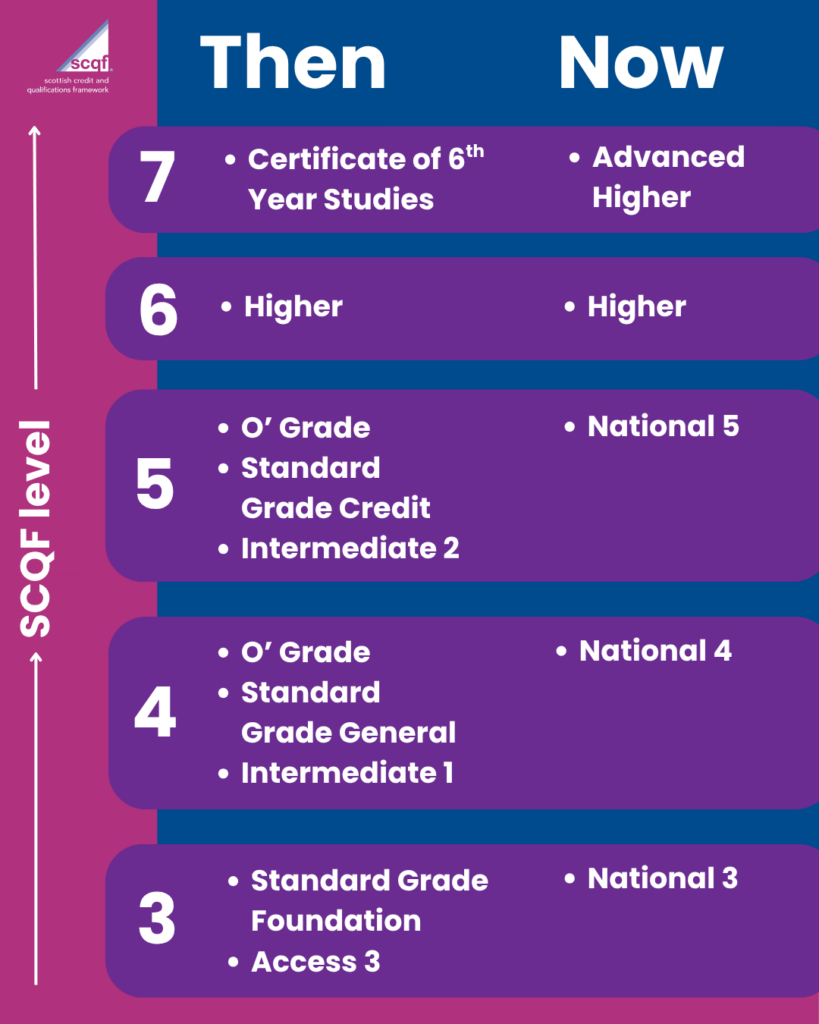
Comparing old vs new qualifications
The names of qualifications have changed over the years, but that doesn’t mean they’re harder, easier or less valuable – they’re just different. To help you make sense of all it, we’ve created a handy guide to help you understand how older qualifications relate to today’s.
View the simplified version, right, or download the more detailed Old V New, which contains more qualifications, such as Skills For Work, National Progression Awards and Foundation Apprenticeships.
By understanding how your qualifications relate to your child’s, you’ll be able to support them with confidence on results day.
Frequently asked questions
Are SCQF credit points the same as UCAS tariff points?
SCQF credit points are not the same as UCAS tariff points. UCAS tariff points relate to the grades you have achieved. SCQF credits are a measure of how long it takes to achieve a qualification, no matter what grade you get.
Why does an ‘A’ at Higher get the same number of SCQF credit points as a ‘C’ at Higher?
The number of SCQF credit points you’ve gained doesn’t change depending on your grade at any particular level. SCQF credits reflect how many hours of learning you’ve done, not how well you’ve learned a subject.
Will my qualifications be recognised if I move abroad?
SCQF levels are referenced against the European Qualifications Framework (EQF), so learning institutions and employers in Europe can easily compare your qualifications against their own country’s qualifications framework.
If I build up SCQF credit points, will I get into college or university?
Not directly, although SCQF credit points help admissions officers in colleges and universities know exactly how much learning you have done and at what level. The admissions officers still have other factors to consider, such as the subjects you studied and grades you achieved.
Will the SCQF help me to get a job?
Not directly, but it will help employers understand the level of difficulty of each qualification, as well as the number of credit points you have achieved as part of your personal development. As your career develops, any work-based qualifications you achieve may add to the number of credits you already have.
What if don’t get the results I expected?
There is more than one path to get you to where you want to go. You can use our interactive framework to help you plan your learning journey. For example, if you want to go to university, but don’t have the grades, you can apply to study an HNC or HND at college. Many colleges have articulation agreements with universities so that students can gain entry into the second or third year of a university course upon completion of their college qualification. Contact your local college for more information. An apprenticeship is also a valuable option that could bring you a step closer to your ideal career.
Results Helpline
Skills Development Scotland’s Results Helpline goes live at 8am on results day.
- Tuesday and Wednesday: 8am to 8pm
- Thursday and Friday: 9am to 5pm
The SDS Results Helpline number is 0808 100 8000.
You can talk to SDS’s expert careers advisers about course vacancies at UK colleges and universities, Confirmation and Clearing, advice about Foundation, Modern, and Graduate Apprenticeships, jobs, volunteering, or staying on at school.
SDS careers advisers are at the end of the phone to help young people and their parents and carers.
There’s also lots of results support on Scotland’s career website, My World of Work – it’s packed with advice, information and resources.
If you would prefer to speak to someone in person, you can visit an SDS centre or community venue to talk to a careers adviser about your results and next steps. No appointment is necessary. Find your nearest centre at Contact us – Skills Development Scotland
BSL users
BSL users can use Contact Scotland BSL for support in speaking to an adviser. You can use their app to sign up with an interpreter who will make the phone call for you. Visit contactscotland-bsl.org
**Before 4 August you can still speak to an adviser by calling 0800 917 8000, Monday to Friday, 9am to 5pm.
Qualifications Scotland support
If something is wrong or missing from your certificate, call your school/college who will contact Qualifications Scotland Support on 0345 279 1000.
For other queries, email mailto:customer@qualifications.gov.scot or phone 0345 279 1000.
Learner support for National Qualifications – Qualifications Scotland
Information on Qualifications Scotland Appeals
Useful links
We offer support for learners and their parents/carers at Support for Learners.
You can also visit Qualifications Scotland, Young Scot and My World of Work and for parents there’s NPFS and Connect.
If you have any further questions relating to SCQF credits or levels, please get in touch via email on info@scqf.org.uk, or connect with us on Facebook or Instagram.
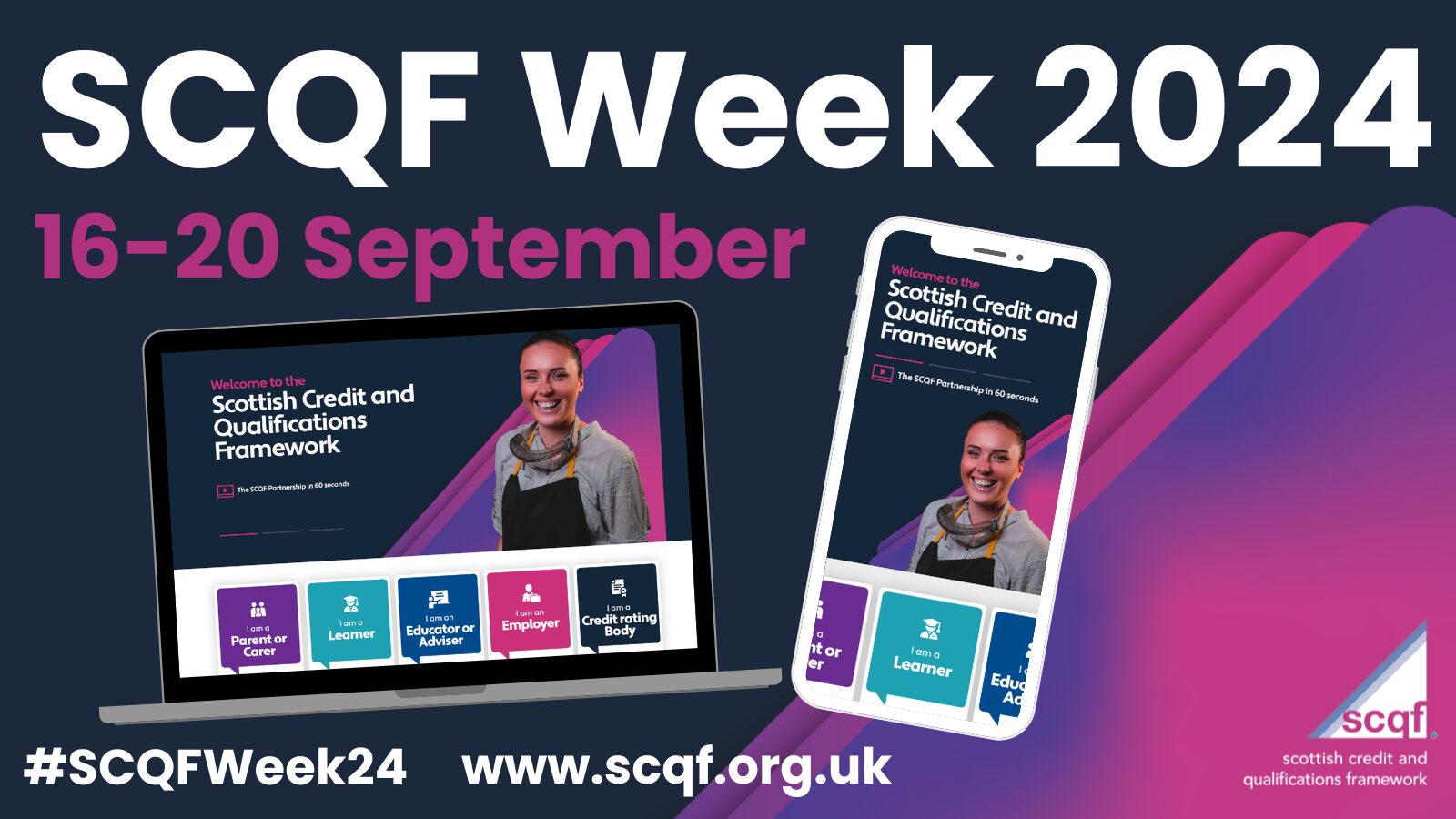
It’s SCQF Week 2024!
This year’s SCQF Week, from September 16 to 20, celebrates our various services and the launch of our brand new website.
SCQF Week will encourage people to share their own SCQF journey or wishes for the future, and will have a specific focus for each day of the week:
- Monday, 16 September – Know your SCQF level
- Tuesday, 17 September – Our Inclusive Recruiter initiative
- Wednesday, 18 September – Credit rating
- Thursday, 19 September – Our School Ambassador programme
- Friday, 20 September – SCQF expertise around the globe
We have created a social media toolkit so you can join in and help us celebrate SCQF Week 2024.
Currie Community High School is a comprehensive, non-denominational school in Southwest Edinburgh, writes John Schmidt, curriculum leader technologies, and Fraser McLachlan, depute head teacher.
We offer a wide range of subjects and qualification levels from Broad General Education (BGE) in S1-3 to the Senior Phase (S4-6). We also offer numerous extracurricular opportunities.
Designated as a Community High School in 1997, Currie shares its extensive facilities with the local community, a practice that will continue when we move to our new building in early 2025. As Scotland’s first Passivhaus secondary school, we are committed to sustainability and a curriculum that helps our students thrive and reach their full potential.
Our SCQF journey
Currie joined the SCQF School Ambassador program in April 2019, marking the start of our Developing the Young Workforce (DYW) journey. We’ve continued to progress, through the challenges of Covid-19, with a focus on expanding opportunities for all learners. This includes not only traditional courses but also interdisciplinary learning that fosters skills development, knowledge, and valuable experiences.
Since our initial SCQF training, we have been enhancing the capacity of staff, students, and parents/carers to understand how the SCQF and a wider range of qualifications can be transformative. This shift in mindset has led to the introduction of additional qualifications at SCQF levels 5 and 6, such as the National Progression Awards (NPA) in Skills for Work Laboratory Science. Additionally, many students are pursuing Foundation Apprenticeships at SCQF level 6 in partnership with Edinburgh College.
Learner pathways
At the core of our Creativity & Employability Strategy (aligned with HGIOS 4 and formerly DYW) is the use of the SCQF to inform our learner pathways. This strategy helps shape the three-to-18 learning journey at Currie, focusing on skills development, industry-recognised qualifications, and careers education. It’s also a key driver for raising attainment and embedding the 15-24 learner journey.
One of our recent developments is the creation of the ‘Pathways with Purpose’ webpage, which combines learner pathways with labour market information and utilises My World of Work to support informed choices. This has raised the profile of vocational qualifications while working to develop parity of esteem.
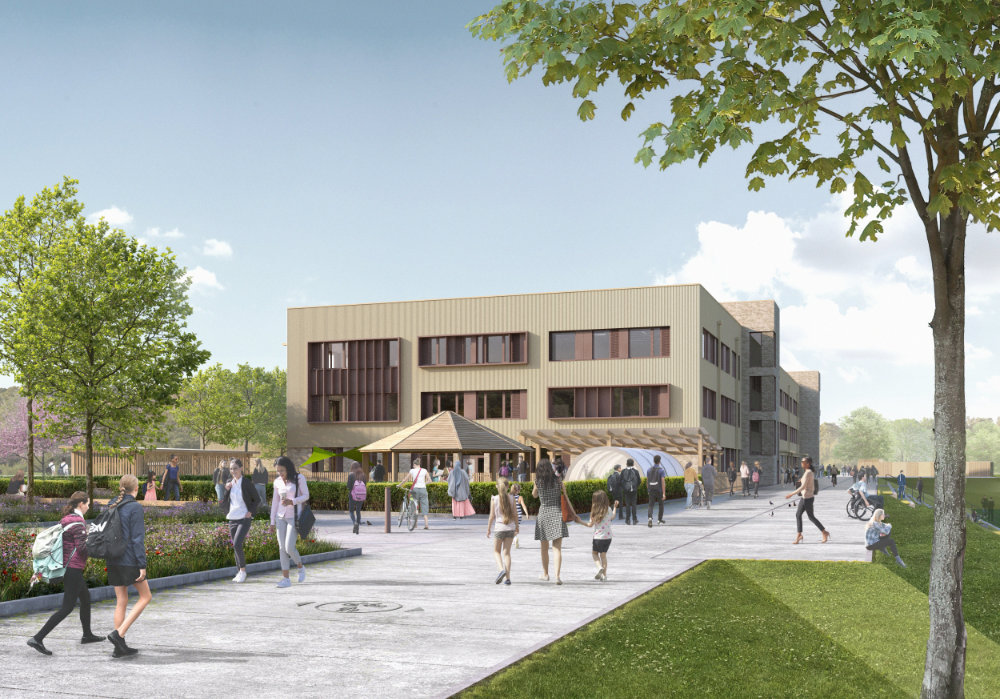

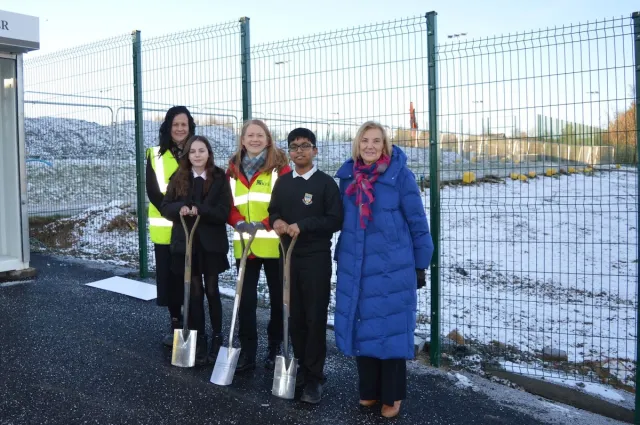
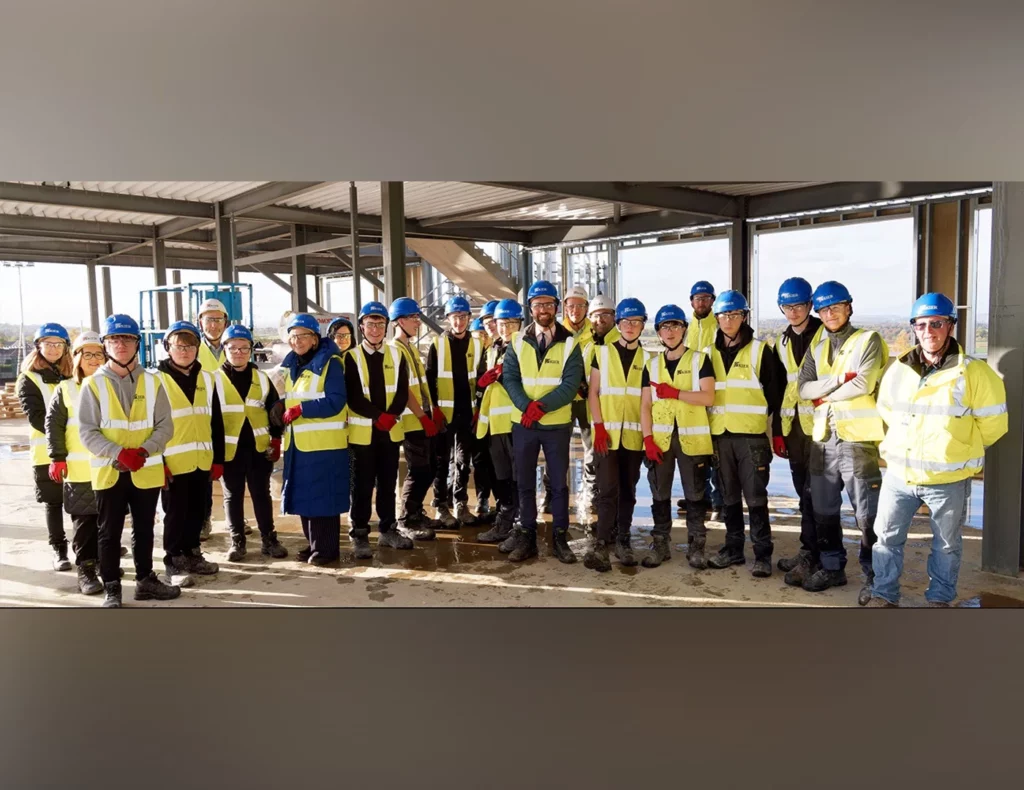
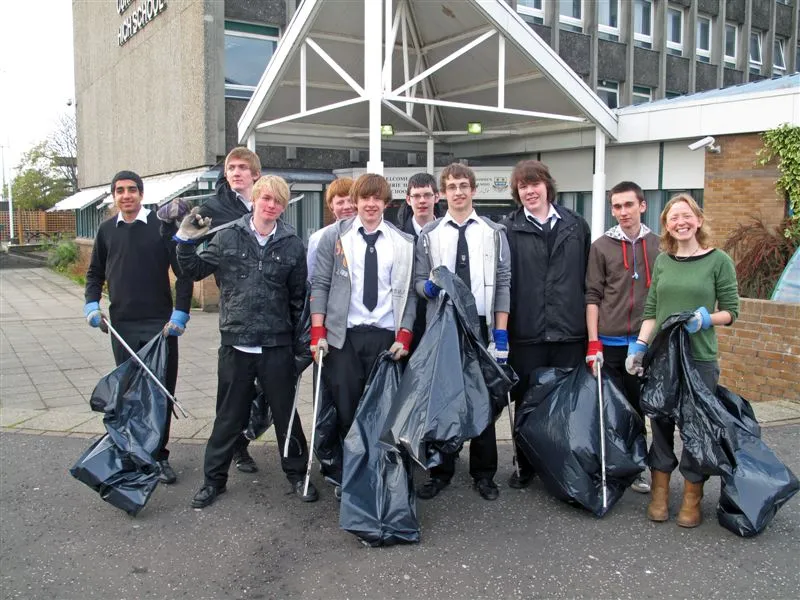
As we prepare to move into our new school, we remain focused on local and national contexts to support improving attainment and achievement for all. Currie consistently surpasses national and city averages in attainment at every stage, and our post-16 stay-on rate is very high, with many students progressing to further and higher education. We support these aspirations by offering a variety of qualifications on the SCQF, including:
- Sports Leaders at levels 4 and 5
- JET Academy leading to the Employability Award at level 4
- Prince’s Trust Achieve leading to a level 4 in Personal Development
- Creative Industries at level 6
- Business with Information Technology at levels 5 and 6
- Enterprise and Business at level 6
- Construction Award at level 5 (linked to new school developments)
- Barista at level 5, among a range of others.
A key focus moving forward is raising awareness and sharing information about the SCQF and qualifications with our stakeholders. We aim for the SCQF to become a ‘common language’ for everyone. We’ve built on past successes, such as distributing leaflets, hosting parents’ evening displays, and attending PiP meetings to emphasize the importance of the SCQF.
Spreading the word
We are enhancing communication by embedding Rights Respecting Schools principles, using interactive resources for course information, producing videos on new course terms like NPAs, sharing the interactive framework on our foyer screen linked to QR codes, and launching our new Pathways with Purpose webpage.
Our next steps as an Ambassador School include:
- Exploring alternative qualifications to suit our learners’ pathways
- providing opportunities for students to learn new skills through interdisciplinary learning
- building capacity and legacy for all students to be ambassadors of the Framework
- continuing to develop opportunities for recognising wider achievements, including opportunities for accreditation, eg. we have created a Leadership Academy
- working towards consistency across our curriculum being right for every child.
For more information about Currie Community High School, visit our website, follow us on X, or explore our silver evidence.
July has been a busy month at the SCQF Partnership, with two new additions to our team. Find out more about Paul White, who joins us as our new Lead for Transnational Opportunities.

What is your role within the SCQFP Team?
I am the Lead for Transnational Opportunities, which is a brand new role. I will be seeking out and leading international projects, as well as providing support to other SCQFP Leads in their areas of expertise.
What do you look forward to achieving in your role?
I’m really excited to enhance the international reputation of the SCQF and expand our networks with partners across the globe.
Tell us a bit about your career to date?
Following an undergraduate Law degree and a master’s in International Relations, I joined Skills Development Scotland (SDS) on their graduate scheme in 2019.
I had several different roles during my time at SDS, with my longest involving working on the development of new Scottish apprenticeships. While there, I collaborated with hundreds of apprentices, employers, training providers, qualification experts and industry bodies.
Tell us something interesting about yourself
I once bungee-jumped 111 metres off the Victoria Falls Bridge, which is over the Zambezi River. I would say I enjoyed the view, but I couldn’t focus on anything other than the fear!
Meet Susan Lauder – the newest addition to the SCQFP team. Susan joins us as an Executive Assistant and brings a wealth of experience.
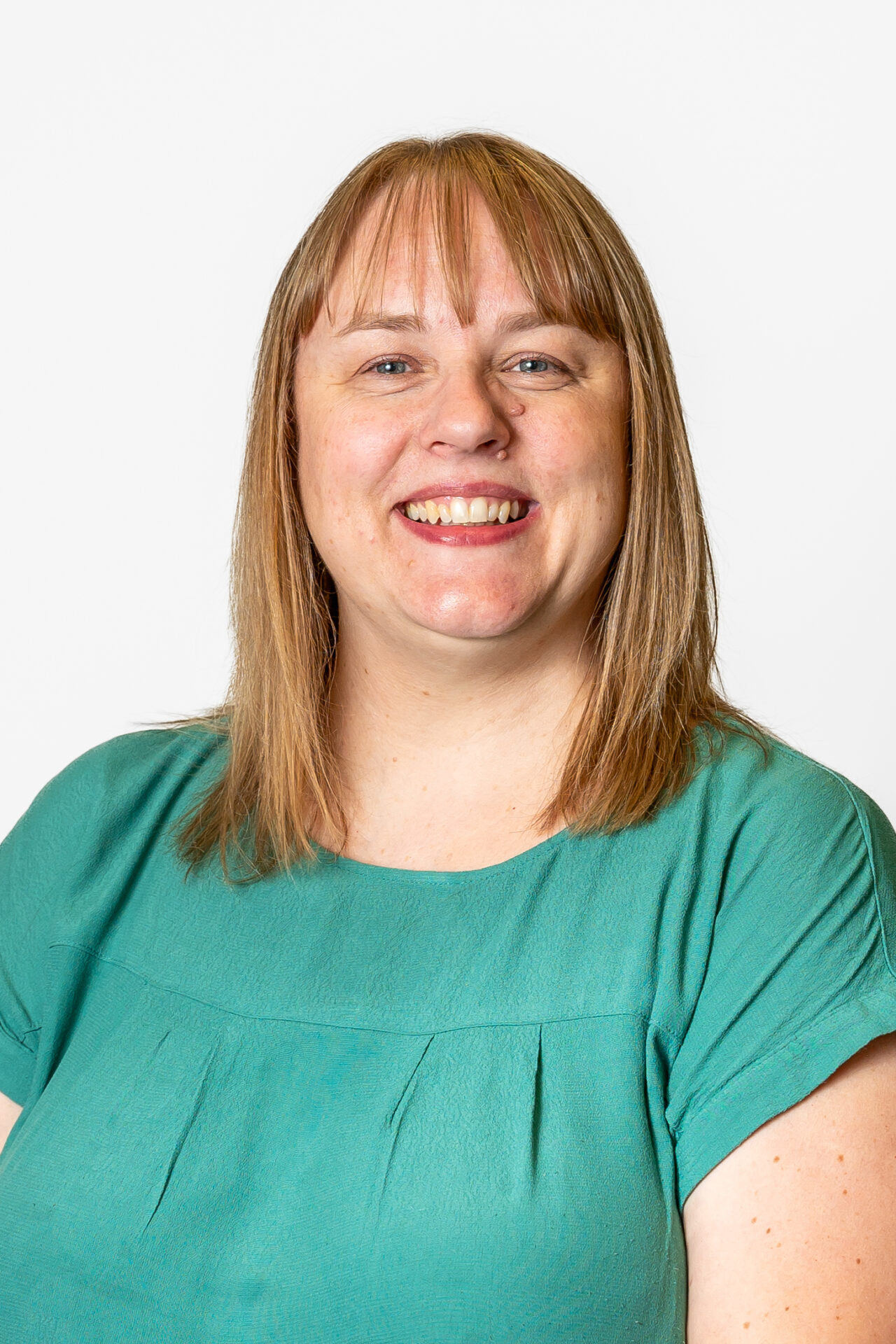
What is your role within the SCQFP Team?
As Executive Assistant I provide high level administrative support to the CEO and senior leadership team, as well as the Board and the various sub-committees. I am also responsible for the day to day office management for the SCQF Partnership.
What do you enjoy most about your role?
Variety! My job role provides a lot of variety in terms of my day to day tasks which allows me to utilise my skills in lots of different ways – and for the things I’m not sure of, there’s always Google!
Tell us a bit about your career to date?
I started my career in administration as an office junior for a firm of solicitors in Glasgow city centre at the tender age of 16. Since then I have held a variety of administrative positions in a wide range of industries including recruitment (where I spent some time on secondment as a recruitment consultant), private healthcare and third sector organisations.
During my career I have also undertaken two SCQF level 7 HNC qualifications; one in Health & Social Care and the other in Counselling Skills.
Before joining the SCQF Partnership I spent nine years providing administrative support for a team of surgeons within NHS Greater Glasgow and Clyde.
Tell us something interesting about yourself
In my spare time, I like to attend the theatre and have a great love of all things musical. I was once lucky enough to get backstage to a well-known musical during its tour of Glasgow where I met some of the cast and even got to step out onto the stage. Thankfully, the auditorium was empty at the time!
Youth work in Scotland plays a crucial role in the development and well-being of young people, impacting their personal growth, social inclusion, community engagement, education and overall health.

The CLD Standards Council Scotland is the professional body for people who work or volunteer in community learning and development in Scotland. This includes adult learning, community development and youth work.
They developed the Scottish Vocational Qualification (SVQ) in Youth Work in partnership with the CLD sector and employers in the public and third sector. The SVQ is a mandatory component in the Modern Apprenticeship in Youth Work.
It is a broad-ranging qualification aimed at school leavers, volunteers, those wishing to upskill and reskill, and for those looking for a pathway to the professional qualification at SCQF level 9 and above.
The qualification offers an understanding and grounding in theory and approaches to youth work, group work skills and the values and ethics underpinned by the CLD Competent Practitioner Framework.
SCQF levels
Set at SCQF levels 6 and 7, and worth 52 SCQF credit points (level 6) or 72 SCQF credit points (level 7), the award aims to develop occupational skills and enhance learners’ future career prospects.
Learners who achieve this SVQ can continue to the SCQF level 7 HNC Working With Communities or progress on to the professional qualification at SCQF level 9, which is offered in Scotland by five universities.
All the SVQ Youth Work units are intended to be practical, where learners are provided with the opportunity to develop as youth work practitioners by working directly with young people in a variety of settings.
The benefits
Steven Maclennan, Development Officer at the CLD Standards Council, said: “This SVQ and Modern Apprenticeship offers learners the chance to work directly with young people and support them in a variety of settings.
“It provides opportunities for learners to engage and practice different types of group work skills, involve young people directly in decision making and links well with the UN Convention on the Rights of a Child.
“Learners will also support young people with digital skills and tools, as well as engage with young people to promote their emotional well-being and mental health. It allows them to take responsibility for elements of programme planning in partnership with young people, and to support the personal and social development of those young people and their communities.
“Learners develop skills in problem solving, group work, reflection, communication, confidence and assertiveness – all of which are widely transferable skills for further study or employment.
“As CLD practitioners, reflection in and on action plays an incredibly important role in our professional development and informs our response to working with young people, and reflection is a core requirement of this SVQ.
“This practical course opens the gateway to becoming a professionally qualified worker and offers a great opportunity to upskill, re-skill and ‘grow your own’ practitioners.”
Grow your workforce
Steven added: “I would encourage organisations to think about whether they can offer this qualification and/or the Modern Apprenticeship to help strengthen and grow their workforce.
“The CLD Standards Council are happy to meet and discuss ‘growing your own practitioners’ with practitioners and organisations.”
Participants
Bethany Mclay, Go! Youth Trust Youth Worker in Falkirk, who has completed the SVQ, said:
“This course has helped me with having a better understanding of the impact of youth work on young people. It has supported me with being able to reflect upon the sessions I do at my work and better support the young people I engage with. I enjoy having the opportunity to learn more about the benefits of youth work and all this entails for helping me in my career. This course has helped boost my confidence and knowledge about the work I do.”
Shania Jensen, Fife Council Youth Worker, who is working towards the qualification, said:
This course has helped me gain confidence as a practising youth worker. It has shown me the importance of youth work and why it’s needed for the young people in our community. I love that I get the opportunity to deliver my work while generating evidence for my vocational qualification in youth work. This allows me to learn on the job and use my vocational studies to better my practice.
Find out more about SQA’s SVQ in Youth Work at SCQF levels 6 and 7 or Community Development at SCQF Levels 5, 6 and 8.
Sustainability is no longer just a buzzword for businesses – it’s a necessity for organisations looking to stay competitive and relevant. As the world’s population continues to grow and resources become more strained, it is vital we adopt practices and policies that promote long-term environmental, economic, and social well-being.
The Institute of Sustainability Studies (ISS) has developed a Diploma in Business Sustainability course at SCQF level 7 aimed at individuals and businesses looking to enhance their sustainable business practices and drive organisational change.
At ISS, we believe all companies can be successful in weaving sustainability into their operations but there is a substantial need to demystify sustainability as a concept. We strive to break down these barriers with hands-on, comprehensive educational courses, backed by some of the world’s leading academics and enterprises.
About our business sustainability courses
Our flagship offering is our Diploma in Business Sustainability course, at SCQF level 7 with 24 credit points, which is designed to equip participants with a deep understanding of key sustainability topics. In addition to our Diploma course, we also have the Certificate in Corporate Sustainability Reporting Directive (CSRD) designed to equip participants with the knowledge and tools needed to master CSRD reporting. We will also be launching other short courses this year and customised course bundles, allowing participants to choose from a diverse range of modules to meet their organisation’s specific needs.
Who are these courses for and why undertake them?
Our courses are ideal for business leaders, managers, employees and entrepreneurs, across all levels of their careers, helping them to gain practical insights and strategies applicable in real time.
Our past participants have come from a range of industries and sectors; for example, retail, hospitality, finance, construction, food, real estate and business consulting.
Developed by expert educators and practitioners, the course content is academically rigorous, relevant and current. Our courses have also been designed to be relevant to organisations of all sizes and capacities.
Being fully online, participants can engage at their convenience, joining a community of like-minded professionals and experts. Additionally, our masterclasses, exclusive to ISS course participants, are led by industry leaders, and provide valuable, up-to-date knowledge and practical strategies.
What benefits does the credit rating of these courses provide for learners completing them?
The SCQF credit rating, undertaken by Glasgow Caledonian University, means that learners can rest assured they are enrolling in a course that has undergone a rigorous process to ensure it meets the highest educational standards. This adds immense credibility to our courses.
Learners told us …
“I couldn’t recommend this course highly enough – an information-dense trip from the drive to net zero to the fundamentals of circular economy. Particularly enjoyed learning how to get ready for CSRD!” – Sheena Crean, Banking Professional
“The Diploma in Business Sustainability course helped 11 Encirc employees gain clarity and understand key sustainability topics, and have insightful and impactful conversations with our clients.” – Theresa Clarke, Environmental Manager, Encirc
“The course was easy to keep on top of while working full-time. It helped me gain a better understanding of key concepts and hit the ground running in my new sustainability role. I also liked the interactive element.” – Mandy Hughes, Sustainability Manager, DeltaQ
The ISS is a pioneering educational institution dedicated to providing practical tools and expert insights to integrate sustainability into various organisational contexts.
To find out more, visit https://instituteofsustainabilitystudies.com/.
