
You’ve spotted “SCQF credit-rated” — level 5, level 7 — on our courses and thought: what does that actually mean south of the border? Here’s the plain-English translation — straight from the official comparison tables.
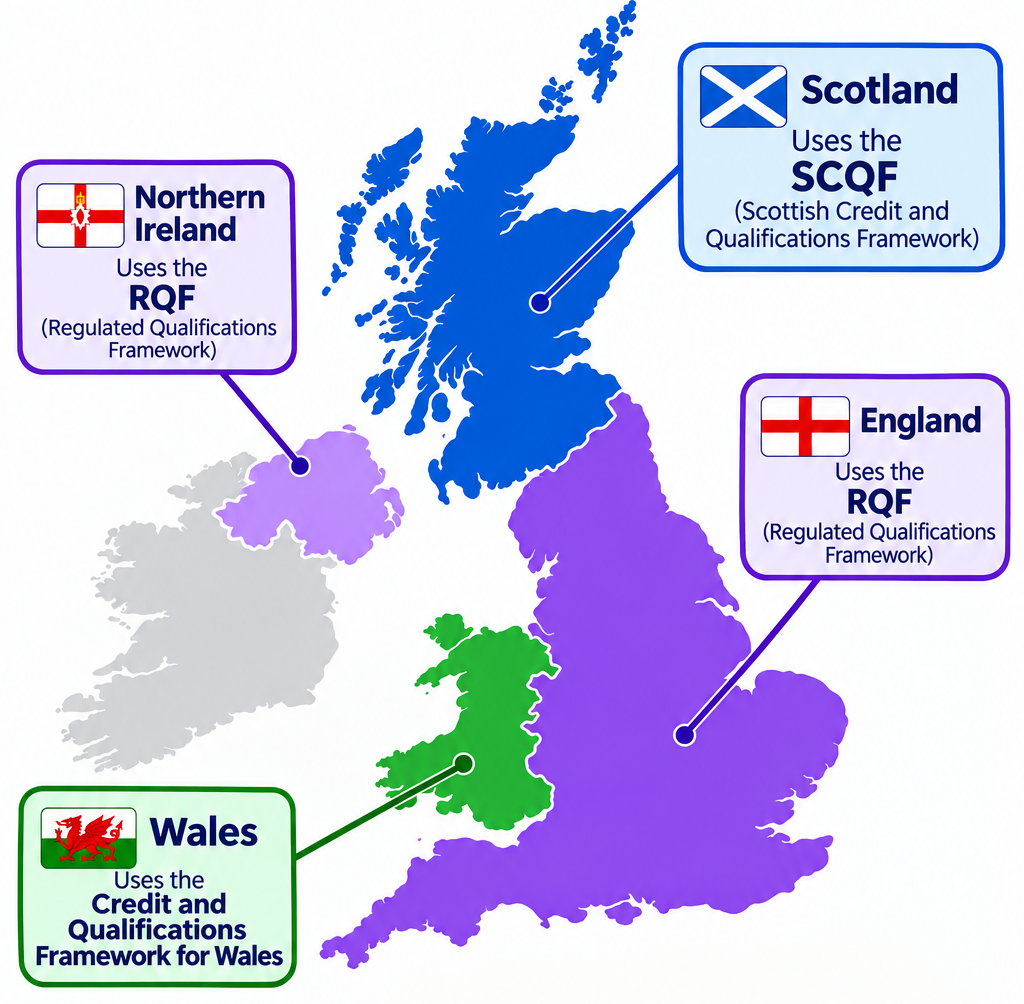
If you manage estates, engineering or compliance teams in England, you’ll be fluent in the language of A-levels, NVQs, HNCs and “level 3” or “level 4” qualifications.
So when a training course arrives on your desk described as SCQF level 5 or SCQF level 7, credit-rated through Qualifications Scotland, it’s fair to ask two questions. What is the SCQF? And is it actually recognised in England?
The short answers: it’s Scotland’s national qualifications framework – the sibling of the system you already know – and yes, it’s formally recognised right across the UK.
But the detail matters, because SCQF numbering looks different from English numbering, and misreading it is easy. This guide gives you the official translation.
What is the SCQF?
The Scottish Credit and Qualifications Framework (SCQF) is Scotland’s national framework for qualifications, in the same way England and Northern Ireland use the Regulated Qualifications Framework (RQF), overseen in England by Ofqual.
Almost every mainstream qualification achieved in Scotland – from school qualifications to doctorates, and including vocational and professional training – sits somewhere on the SCQF.
Every programme on the Framework carries two numbers:
- An SCQF level (1 to 12) – how demanding the learning is. Level 1 covers the most basic learning outcomes; level 12 is doctorate territory.
- Credit points – how much learning is involved. One SCQF credit point represents ten notional hours of learning, including study and assessment time, not just classroom hours.
So a qualification badged “SCQF level 7, 6 credit points” tells you at a glance both the intellectual demand and the volume of learning behind it.
That precision is the whole point of the Framework – and it’s exactly what a certificate of attendance can’t tell you.
The English translation: SCQF vs RQF
Here’s where English readers usually stumble. The SCQF runs from 1 to 12; the RQF runs from Entry Level to Level 8.
The numbers do not line up one-for-one, so a Scottish level always looks higher than its English equivalent. An SCQF level 7 qualification is not the same as an RQF Level 7 (which is master’s degree level) — and, equally, it’s well above an RQF level 3.
The table below shows the levels you’ll most often meet on technical training, drawn from the official comparison published by Qualifications Scotland (formerly the Scottish Qualifications Authority, SQA):
National framework qualifications comparison table
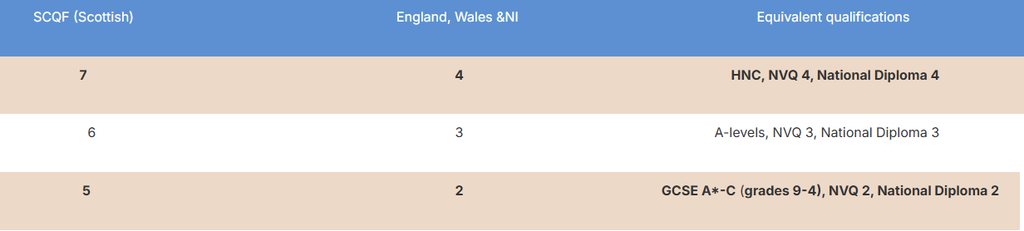
The full official table covers all 12 SCQF levels, right up to doctorate (SCQF 12 = level 8 in England).
An SCQF level 7 qualification sits a full step above A-levels — the same rung as an HNC in England.
Worked examples: SCQF levels 5 and 7 in English terms
Take the two levels you’ll most often meet on technical training. An SCQF Level 5 qualification corresponds to RQF Level 2 in England – GCSE standard (A*–C /grades 9–4) – the level at which someone can competently carry out skilled, well-defined technical tasks to established procedures.
An SCQF level 7 qualification corresponds to RQF level 4 – beyond A-level standard, in the same territory as an HNC or the first year of a degree – demanding critical understanding, analysis and evaluation of complex technical information.
The point isn’t these two levels in particular: the Framework works identically at every one of its 12 rungs.
Whatever level appears on a credit-rated course – ours included, from operational programmes at SCQF level 5 to our 5-Day Authorised Person (Ventilation) training at SCQF level 7 — the same official table translates it into its English equivalent.
Is an SCQF qualification recognised in England?
Yes. This is the question we’re asked most often by English clients, and the answer is unambiguous.
The SCQF and the RQF are formally referenced against each other, and both are referenced against the European Qualifications Framework (EQF).
Qualifications from either framework are treated as comparable at the mapped level across the UK – an SCQF-credit-rated programme is no more “just Scottish” than an English HNC is “just English”.
Insight for procurement teams
When a tender or competence audit asks for evidence of accredited training, cite the SCQF level, the credit points and the credit-rating body, and include the RQF equivalence from the official Qualifications Scotland comparison table. That combination answers the “is it recognised?” question before an auditor needs to ask it.
Credit-rated training vs a certificate of attendance
Understanding the levels is half the story. The other half is the phrase credit-rated – and this is where the framework earns its keep for compliance buyers.
A great deal of technical training in the UK is certificated only in the sense that you receive a PDF for turning up. Nobody independent has assessed how demanding the course is, how much learning it involves, or whether the assessment proves anything.
Credit rating is different. Before a programme can join the SCQF, a credit rating body – in our case, working with Qualifications Scotland – must scrutinise it and formally confirm three things:
- Its level – the learning outcomes genuinely sit at the claimed point on the Framework;
- Its credit points – the notional learning hours have been measured and verified;
- Its quality assurance – the design, delivery and assessment have been independently checked.
A certificate of attendance proves someone was in the room. A credit-rated qualification proves what they can now do.
For healthcare estates in particular, that distinction has teeth. Guidance such as HTM 03-01 (specialised ventilation in healthcare premises) expects authorised persons and other key roles to be demonstrably competent.
When your training evidence carries an SCQF level and credit points, competence stops being an assertion and becomes a verifiable record.
What this means for your team

M&M Consultancy & Training Services is based in Scotland, and our courses are credit-rated to the SCQF- but the majority of the standards we train against, from HTM 03-01 to its Scottish counterpart SHTM 03-01, apply on both sides of the border, and our courses are developed and delivered by NHS-appointed authorising engineers who work UK-wide.
For an English employer, choosing an SCQF credit-rated course means:
- Recognition – a nationally qualification at every level of the framework (SCQF level 5 maps to NVQ level 2; SCQF level 7 to NVQ level 4)
- Audit-ready evidence – level and credit points that slot directly into a competence management system;
- Comparability – a common currency for mixed teams holding Scottish and English qualifications.
Frequently asked questions
What is SCQF level 7 equivalent to in England?
RQF level 4 – a step above A-levels, comparable to an HNC or NVQ 4, according to the official Qualifications Scotland comparison table.
What is SCQF level 5 equivalent to in England?
RQF level 2 — broadly GCSE standard (A*–C /grades 9–4), alongside NVQ 2. The same official comparison table covers every SCQF level, so any credit-rated course can be translated the same way.
Is SCQF the same as an NVQ?
No. An NVQ (or SVQ in Scotland) is a type of qualification; the SCQF is the framework the qualification sits on. SVQs, HNCs, degrees and credit-rated professional courses all occupy levels on the same framework.
Do English employers and auditors accept SCQF qualifications?
Yes. Because the SCQF and RQF are formally referenced against each other and against the EQF, an SCQF credit-rated qualification is recognised UK-wide. Quote the level, credit points and the RQF equivalence in your competence records.
Useful links
Qualifications Can Cross Boundaries – compare qualification levels across the UK and Europe
Qualifications Scotland — Comparing qualification levels
NHS England » Health Technical Memorandum 03-01: Specialised ventilation for healthcare premises
M&M Compliance Training Services – Training Courses
Learn more about qualification levels in England, Wales & Northern Ireland